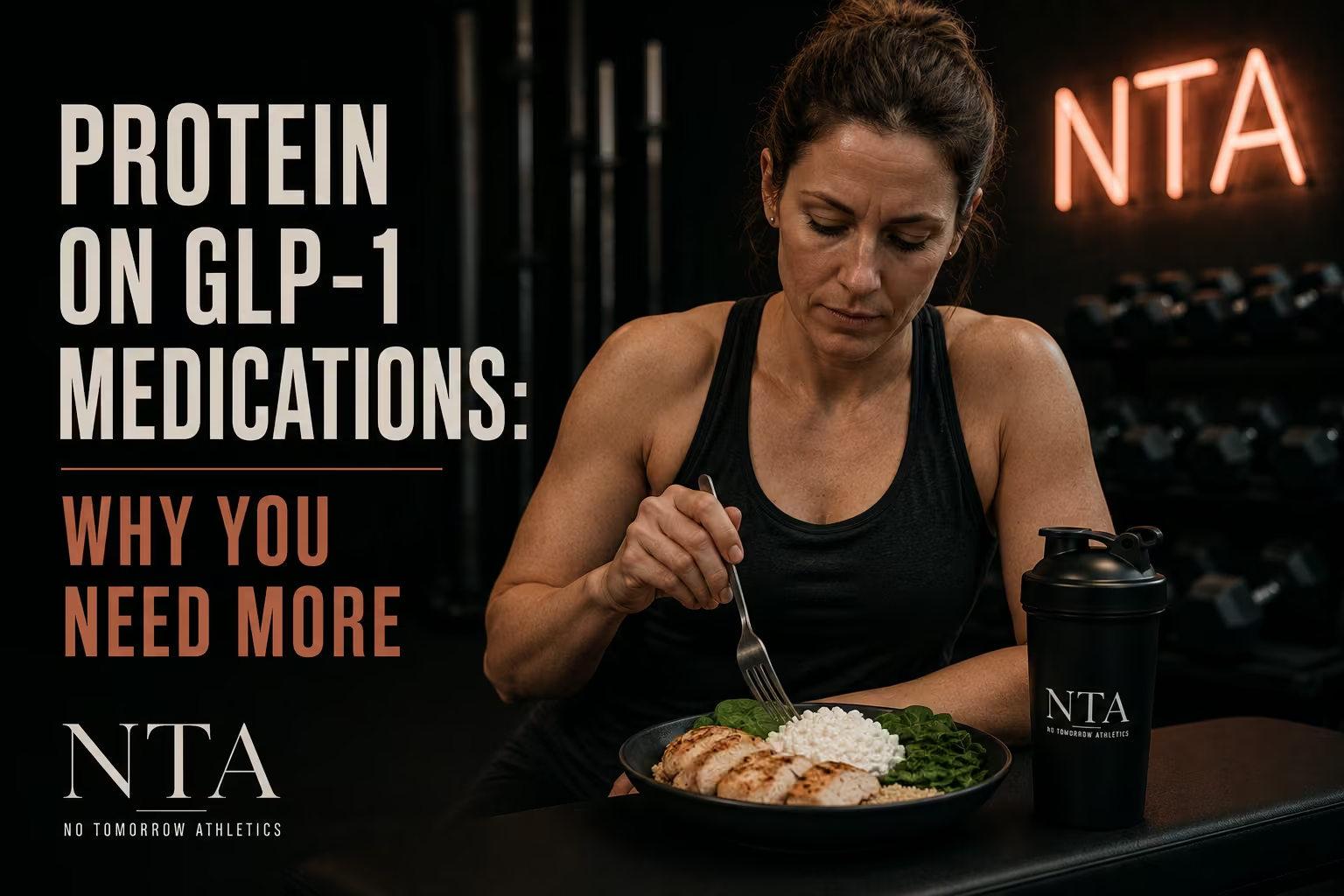
Most people on GLP-1 medications are losing muscle. They do not know it yet.
The medications work. Appetite drops, calories drop, bodyweight drops. But without a deliberate strategy around protein intake on GLP-1 medications, a significant portion of what you lose will not be fat. It will be lean mass — the tissue that determines your metabolic rate, your physical capacity, and your long-term health outcomes. At No Tomorrow Athletics, this is not a wellness concern. It is a performance and longevity problem with a specific nutritional fix.
What GLP-1 Medications Actually Do to Your Appetite
GLP-1 agonists — semaglutide (Ozempic, Wegovy), tirzepatide (Mounjaro, Zepbound), and related compounds — work by mimicking the glucagon-like peptide-1 hormone, which signals satiety and slows gastric emptying 1. The result is a dramatic reduction in hunger that enables most users to sustain a meaningful caloric deficit without feeling deprived.
That deficit is the point. For individuals with obesity or metabolic dysfunction, the caloric restriction created by these medications drives clinically significant weight loss. The problem is what the medication does not do.
It does not selectively suppress your appetite for low-quality food. It suppresses appetite globally — including your appetite for protein. Most GLP-1 users are eating far less protein than they were before starting the medication, simply because they are not hungry enough to eat much of anything. The medication does not care. It cannot distinguish between a bag of chips and a chicken breast.
The Mechanism: Anabolic Resistance and Why You Need More, Not Less
Here is the core problem. At the same time that GLP-1 users are eating less protein, the caloric deficit created by the medication increases anabolic resistance — a reduction in skeletal muscle's sensitivity to the anabolic signal that protein provides 2.
Under normal fed conditions, adequate protein intake drives muscle protein synthesis (MPS) through leucine-triggered mTOR pathway activation. In a significant caloric deficit, that signaling becomes blunted. The muscle does not respond as efficiently to the same dose of protein. You need a larger stimulus to generate the same MPS response.
What the Research Says
General protein recommendations for active adults sit at 1.2–1.6g per kilogram of bodyweight per day, consistent with ISSN and ACSM guidelines 3. But for individuals in a sustained caloric deficit — particularly those using GLP-1 medications — current evidence points toward requirements as high as 2.0–2.4g/kg/day to preserve lean mass and support resistance training adaptation 4.
For a 180-pound (82kg) athlete, that is 164–197 grams of protein per day. On a suppressed appetite. On 1,600–1,800 total calories. That is the nutritional challenge.
Muscle Loss Is Not Inevitable — But It Is the Default
The SURMOUNT-1 trial demonstrated that tirzepatide users lost significant bodyweight, but roughly 25–39% of that loss came from lean mass depending on dosage and context 5. That number is not acceptable for an athlete. A 2024 review in Obesity Reviews confirmed that without resistance training and high protein intake, GLP-1-induced weight loss carries a substantial lean mass loss penalty 6.
The medication suppresses your appetite globally. It does not know to spare your protein intake. That is your job.
The No Tomorrow Athletics Position
Protein is the nutritional infrastructure of the Strength pillar. Without it, the training stimulus cannot produce adaptation. You can follow the No Tomorrow Method to the letter — the compound lifts, the conditioning blocks, the structural work — and still lose ground if your protein intake is insufficient to support repair and synthesis.
On GLP-1 medications specifically, protein becomes the single most important dietary variable. Not total calories. Not macronutrient ratios. Protein. Everything else is secondary to hitting your daily gram target.
This is not a recommendation to eat more than your body can handle. It is a prescription to be deliberate and structured in a way that appetite-driven eating no longer supports.
How to Hit 150–180g of Protein on a Suppressed Appetite
The practical challenge is real. If you are eating 1,600–1,800 calories per day on a GLP-1 medication, you have limited volume to work with. Every meal needs to earn its place. Here is how to do it.
Prioritize High-Density Protein Sources
Calorie-efficient, protein-dense foods do the most work in a compressed eating window. These are the ones to build every meal around.
- Non-fat Greek yogurt: 17–20g protein per cup, ~120 calories
- Cottage cheese (low-fat): 25g protein per cup, ~180 calories
- Eggs and egg whites combined: flexible, easy to digest, high biological value
- Lean ground turkey or chicken breast: 30–35g per 4oz cooked serving
- Canned tuna or salmon: 25g protein per 3.5oz, portable and fast
- Shrimp: 20g protein per 3oz, almost no caloric overhead
These are not exciting foods. They are effective tools. The goal is function.
Time Protein Around Training
Research consistently supports protein ingestion in the hours surrounding a resistance training session to maximize MPS 7. For GLP-1 users dealing with anabolic resistance, this timing becomes even more important. A dose of 40–50g of high-quality protein within 1–2 hours post-training is a reliable target.
If appetite is suppressed post-training, a protein shake is appropriate and efficient — not a compromise. At 25–40g of protein for 130–200 calories, a whey or casein-based shake delivers the leucine threshold needed to trigger MPS without requiring a full meal 8.
Front-Load Protein Early
Appetite on GLP-1 medications tends to be most accessible earlier in the day and diminishes significantly by evening. Build your meal structure accordingly.
A target daily structure for 150–180g of protein on 1,600–1,800 calories might look like this:
- Breakfast: 4 whole eggs + 4 egg whites scrambled, 1 cup Greek yogurt — approximately 55g protein, 500 calories
- Post-training shake: 1.5 scoops whey protein in water — approximately 40g protein, 180 calories
- Lunch: 6oz grilled chicken breast, 1 cup cottage cheese, greens — approximately 60g protein, 500 calories
- Dinner: 5oz salmon or lean ground turkey, vegetables — approximately 35–40g protein, 450–550 calories
Total: approximately 190–195g protein, 1,630–1,730 calories. This is achievable. It requires planning, not heroic appetite.
What About Leucine Threshold?
Anabolic resistance changes the leucine threshold — the minimum dose of leucine required to meaningfully stimulate MPS. In a caloric deficit, research suggests individual protein doses may need to reach 40–50g (rather than the standard 20–30g) to clear that threshold reliably 24. This means spreading protein across 4 meals rather than 3, and making each meal protein-forward rather than treating protein as a side component.
The Integration with Training
None of this works without the training. Protein intake and resistance training are co-requisites for lean mass preservation on a GLP-1. The protein provides the raw material. The training provides the stimulus that tells the body to use it for muscle rather than allowing it to be oxidized for energy.
At No Tomorrow Athletics, athletes on GLP-1 medications are coached to treat their protein target as a non-negotiable daily output — the same way they treat showing up to train. The medication handles the caloric deficit. The athlete handles the protein. That is the division of labor.
If you are currently on a GLP-1 medication and have not audited your daily protein intake, do it today. Track one full day. Most people find they are hitting 60–90g on a suppressed appetite. That is less than half of what the evidence supports for their situation.
Know your bodyweight in kilograms. Multiply by 2.0 at minimum. That is your floor. Build your meals around hitting it.
Sources
- Nauck MA, Meier JJ. Incretin Hormones: Their Role in Health and Disease. Diabetes, Obesity and Metabolism, 2018.
- Trommelen J, van Lieshout GAA, Nyakayiru J, Holwerda AM, Smeets JSJ, Hendriks FK, van Kranenburg JMX, Zorenc AH, Senden JM, Goessens JPB, Verdijk LB, van Loon LJC. The Anabolic Response to Protein Ingestion During Recovery from Exercise Has No Upper Limit in Magnitude and Duration In Vivo in Humans. Cell Reports Medicine, 2023.
- Stokes T, Hector AJ, Morton RW, McGlory C, Phillips SM. Recent Perspectives Regarding the Role of Dietary Protein for the Promotion of Muscle Hypertrophy with Resistance Exercise Training. Nutrients, 2018.
- Carbone JW, Pasiakos SM. Dietary Protein and Muscle Mass: Translating Science to Application and Health Benefit. Nutrients, 2019.
- Jastreboff AM, Aronne LJ, Ahmad NN, Wharton S, Connery L, Alves B, Kiyosue A, Zhang S, Liu B, Bunck MC, Stefanski A; SURMOUNT-1 Investigators. Tirzepatide Once Weekly for the Treatment of Obesity. New England Journal of Medicine, 2022.
- Karakasis P, Patoulias D, Fragakis N, Mantzoros CS. Effect of Glucagon-Like Peptide-1 Receptor Agonists and Co-Agonists on Body Composition: Systematic Review and Network Meta-Analysis. Metabolism, 2025.
- Areta JL, Burke LM, Ross ML, Camera DM, West DWD, Broad EM, Jeacocke NA, Moore DR, Stellingwerff T, Phillips SM, Hawley JA, Coffey VG. Timing and Distribution of Protein Ingestion During Prolonged Recovery from Resistance Exercise Alters Myofibrillar Protein Synthesis. Journal of Physiology, 2013.
- Tang JE, Moore DR, Kujbida GW, Tarnopolsky MA, Phillips SM. Ingestion of Whey Hydrolysate, Casein, or Soy Protein Isolate: Effects on Mixed Muscle Protein Synthesis at Rest and Following Resistance Exercise in Young Men. Journal of Applied Physiology, 2009.
Frequently Asked Questions
About the author
.avif)