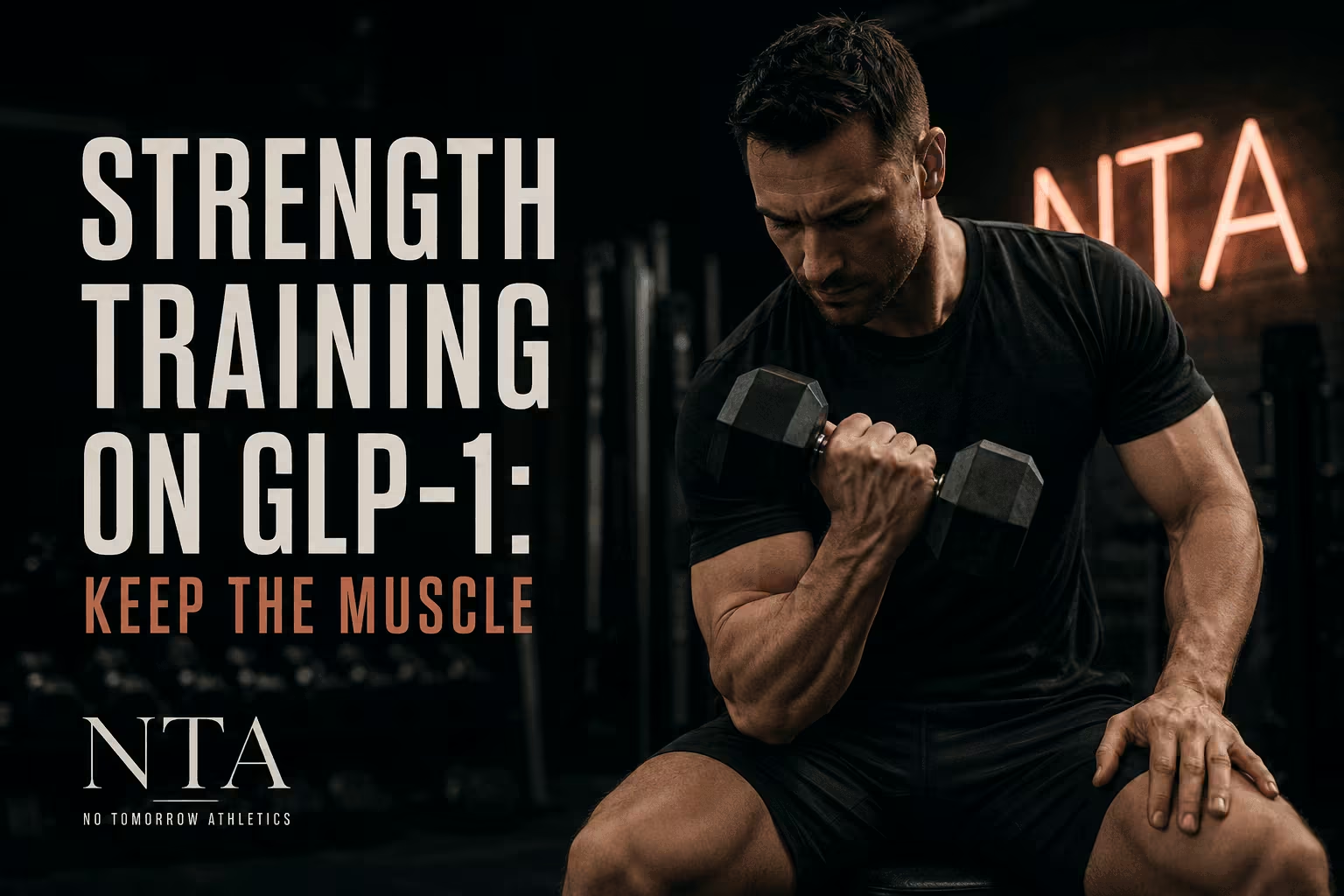
For every 10 pounds lost on a GLP-1 medication, up to 4 of those pounds may be muscle. That is not a buried disclaimer. It is a documented pattern across clinical trials, and it changes the entire conversation about what these medications actually do to your body.
GLP-1 receptor agonists — semaglutide, tirzepatide — are legitimate tools with a real evidence base. The question is not whether they work. They do. The question is what the weight is made of when you finish, and whether the body you are left with is healthier than the one you started with. Those are not the same question, and the answer depends almost entirely on whether you are resistance training while you use them.
What GLP-1 Medications Actually Do — and Where the Problem Starts
GLP-1 receptor agonists work primarily by suppressing appetite and slowing gastric emptying, creating a sustained caloric deficit that most people cannot maintain through willpower alone.¹ That deficit is the mechanism of action. It is also the mechanism of muscle loss.
A caloric deficit without a resistance training stimulus gives the body no signal to protect muscle tissue. Muscle is metabolically expensive — it costs energy to maintain at rest. In a sustained energy shortage, the body draws from both fat stores and protein stores for fuel, because it has no biological reason to prioritize tissue it is not being asked to use. The medication does not direct what gets lost. It creates the conditions. The training — or the absence of it — determines the composition of what you lose.
This distinction matters more than most patients are told before starting treatment.
What the Clinical Data Actually Shows
The SURMOUNT-1 trial, one of the largest and most cited tirzepatide studies, confirmed that participants achieved significant total weight loss — but that lean body mass represented a substantial portion of what was reduced.² Subsequent analysis across both semaglutide and tirzepatide trials consistently shows the same pattern: in the absence of structured resistance training, 25 to 40% of total weight lost comes from lean mass rather than fat.³
On a 30-pound loss, that is 10 to 12 pounds of muscle.
The clinical consequence of losing that much muscle is not cosmetic. Each pound of lean mass burns approximately 6 calories per day at rest.⁴ Losing 10 pounds of it reduces resting metabolic rate by roughly 60 calories per day. That sounds modest until you account for what happens after the medication ends. Appetite returns. But the metabolic rate it returns to is not the same one that existed before treatment — it is suppressed, proportionally to how much muscle was lost. That is the physiological setup for fat regain, and it is established before a single extra meal is eaten.
Clinicians describe the outcome of losing lean mass while retaining or regaining fat as sarcopenic obesity — a condition associated with higher rates of metabolic dysfunction, insulin resistance, and long-term physical decline than simple obesity.⁵ The concern with GLP-1 medications used without resistance training is not that they fail. It is that they succeed in producing weight loss while quietly creating a worse metabolic foundation in the process.
Why the Problem Compounds Over Time
In a sustained caloric deficit, the body develops anabolic resistance — a reduction in sensitivity to the signals that normally drive muscle protein synthesis.⁶ Under normal conditions, training and adequate protein intake activate the mTOR pathway and tell the body to build and preserve muscle tissue. In a prolonged deficit, those signals become less effective. The body requires a larger stimulus to produce the same response.
This creates a problem that is specific to GLP-1 therapy and worth understanding clearly. The medication suppresses appetite broadly — including the appetite for protein — so most patients are eating less protein than they need at the exact moment when protein requirements are elevated. At the same time, the deficit itself makes the body less responsive to whatever training and protein stimulus is provided. The result is that patients on GLP-1 medications need more structured training and more protein than they would under normal conditions, precisely when the medication makes both harder to achieve.
This is not an argument against GLP-1 therapy. It is the case for understanding what the therapy demands from the rest of your protocol. How to hit adequate protein when appetite is suppressed is covered in detail in our protein on GLP-1 medications guide. The full picture of how much muscle is actually lost without training — and what rebuilding it requires — is in our muscle loss on Ozempic breakdown.
The Only Intervention That Consistently Works
Progressive resistance training is not one option among several for managing body composition during GLP-1 therapy. It is the one with consistent, replicated evidence across populations, deficit magnitudes, and treatment durations.
The mechanism is direct. Compound resistance training activates the mTOR signaling pathway, which governs muscle protein synthesis.⁶ That signal overrides the body's default response to energy shortage. It tells the body that muscle tissue is actively being recruited and must be maintained. Without that signal, there is no physiological argument for preservation. A 2022 meta-analysis in Obesity Reviews, examining 12 systematic reviews and 149 studies, found that resistance training during energy restriction consistently preserved significantly more lean mass than diet alone — across populations, ages, and deficit magnitudes.⁷ The training variable was the determining factor.
The medication creates the deficit. The training determines what that deficit removes from your body.
The Minimum Effective Dose
Three days per week of dedicated resistance training is the floor. The sessions should center on compound, multi-joint movements: squat, hinge, horizontal press, vertical press, horizontal pull, vertical pull. These patterns recruit the most total muscle mass and generate the strongest adaptation signal.
Load should sit in the range of 65–85% of your one-rep maximum — the range consistently associated with both hypertrophy and lean mass preservation in the research.⁸ Volume of 3 to 4 sets per movement, at appropriate intensity, is sufficient to drive adaptation. And the stimulus must increase over time. The same weights at the same volume stop producing an adaptation signal within weeks — which is why progressive overload is not a preference. It is the mechanism.
At No Tomorrow Athletics, this is the architecture of the Strength pillar of the No Tomorrow Method. Not general fitness. Deliberate, systematic resistance training designed to produce a documented physiological response. GLP-1 users who train at NTA do the same program as every other member, because the physiology is the same: your body needs a reason to keep its muscle.
If you are on a GLP-1 medication, here is the minimum effective dose.
The Nutritional Layer
Training alone does not preserve lean mass without adequate protein. The two are synergistic — training provides the signal, protein provides the substrate. Without sufficient protein available, the mTOR pathway is activated but cannot complete the synthesis response.
Current evidence supports 1.6 to 2.2 grams of protein per kilogram of bodyweight per day for individuals in a deficit who are resistance training.⁹ Given the anabolic resistance that develops with prolonged caloric restriction, the higher end of that range is appropriate for most GLP-1 users. The practical challenge is achieving it when appetite suppression reduces hunger for protein alongside everything else. Prioritize protein in every meal before other macronutrients. Use high-density sources that allow you to hit your targets without requiring large food volume — Greek yogurt, cottage cheese, eggs, lean meat, whey protein.
The full weekly training structure built around this protocol, with session-by-session detail, is in our exercise program for GLP-1 users post.
Practical Protein Strategy When Appetite Is Suppressed
GLP-1 medications reduce hunger significantly. That is the point. But reduced hunger can lead to under-eating protein, which undermines the lean mass preservation the training is working to achieve. Prioritize protein in your meals before other macronutrients. If appetite suppression is severe, high-quality protein sources with lower volume — Greek yogurt, cottage cheese, eggs, whey protein — allow you to hit targets without requiring large meal volume.
The interaction between training stimulus and protein availability is not additive. It is synergistic. Both are required. Neither works fully without the other 10.
What This Means for How You Think About Treatment
Lean body mass is a metabolically active organ. It is a primary driver of insulin sensitivity, resting metabolic rate, bone density, and functional longevity.⁴ Losing it accelerates the very metabolic dysfunction that GLP-1 medications are often prescribed to address. Preserving it — through structured resistance training and adequate protein — is what separates a medication cycle that improves long-term metabolic health from one that temporarily reduces a number on a scale.
GLP-1 medications work. Used correctly, with resistance training built into the protocol from the start, they can produce meaningfully better body composition outcomes than either intervention alone. Used without training, the pattern in the data is consistent: a significant portion of what is lost is muscle, resting metabolic rate declines in proportion, and the physiological conditions for fat regain are in place before the medication ends.
Strength training on GLP-1 medications is not an add-on. It is the infrastructure that determines the outcome of the therapy.
What No Tomorrow Athletics Offers
The No Tomorrow Method was built around three pillars — Strength, Conditioning, and Mobility — because no single element produces a complete athlete or a durable body. GLP-1 users who train with us are not in a separate program. They are doing the same structured, progressive resistance work that every member does, because the physiology is the same: your body needs a reason to keep its muscle.
If you are in Essex County, NJ, or willing to make the drive, and you are currently on a GLP-1 medication without a structured resistance training program, this is the most important change you can make right now.
Founding member spots at No Tomorrow Athletics are open. This is the earliest access, the lowest pricing, and the most direct access to the coaches who built this program. If you are serious about making your medication work the way it is supposed to, start here.
Sources
- Drucker DJ. The Biology of Incretin Hormones. Cell Metabolism, 2006.
- Jastreboff AM, Aronne LJ, Ahmad NN, Wharton S, Connery L, Alves B, Kiyosue A, Zhang S, Liu B, Bunck MC, Stefanski A; SURMOUNT-1 Investigators. Tirzepatide Once Weekly for the Treatment of Obesity. New England Journal of Medicine, 2022.
- Christoffersen BØ, Sanchez-Delgado G, John LM, Ryan DH, Raun K, Ravussin E. Beyond Appetite Regulation: Targeting Energy Expenditure, Fat Oxidation, and Lean Mass Preservation for Sustainable Weight Loss. Obesity, 2022.
- Wolfe RR. The Underappreciated Role of Muscle in Health and Disease. American Journal of Clinical Nutrition, 2006.
- Burd NA, Gorissen SH, van Loon LJC. Anabolic Resistance of Muscle Protein Synthesis with Aging. Exercise and Sport Sciences Reviews, 2013.
- Wilkinson DJ, Hossain T, Hill DS, Phillips BE, Crossland H, Williams J, Loughna P, Churchward-Venne TA, Breen L, Phillips SM, Etheridge T, Rathmacher JA, Smith K, Szewczyk NJ, Atherton PJ. Effects of Leucine and Its Metabolite β-Hydroxy-β-Methylbutyrate on Human Skeletal Muscle Protein Metabolism. Journal of Physiology, 2013.
- Lopez P, Taaffe DR, Galvão DA, Newton RU, Nonemacher ER, Wendt VM, Bassanesi RN, Turella DJP, Rech A. Resistance Training Effectiveness on Body Composition and Body Weight Outcomes in Individuals with Overweight and Obesity Across the Lifespan: A Systematic Review and Meta-Analysis. Obesity Reviews, 2022.
- Schoenfeld BJ, Contreras B, Krieger J, Grgic J, Delcastillo K, Belliard R, Alto A. Resistance Training Volume Enhances Muscle Hypertrophy but Not Strength in Trained Men. Medicine and Science in Sports and Exercise, 2019.
- Stokes T, Hector AJ, Morton RW, McGlory C, Phillips SM. Recent Perspectives Regarding the Role of Dietary Protein for the Promotion of Muscle Hypertrophy with Resistance Exercise Training. Nutrients, 2018.
- Moore DR. Protein Requirements for Master Athletes: Just Older Versions of Their Younger Selves. Sports Medicine, 2021.
Frequently Asked Questions
About the author