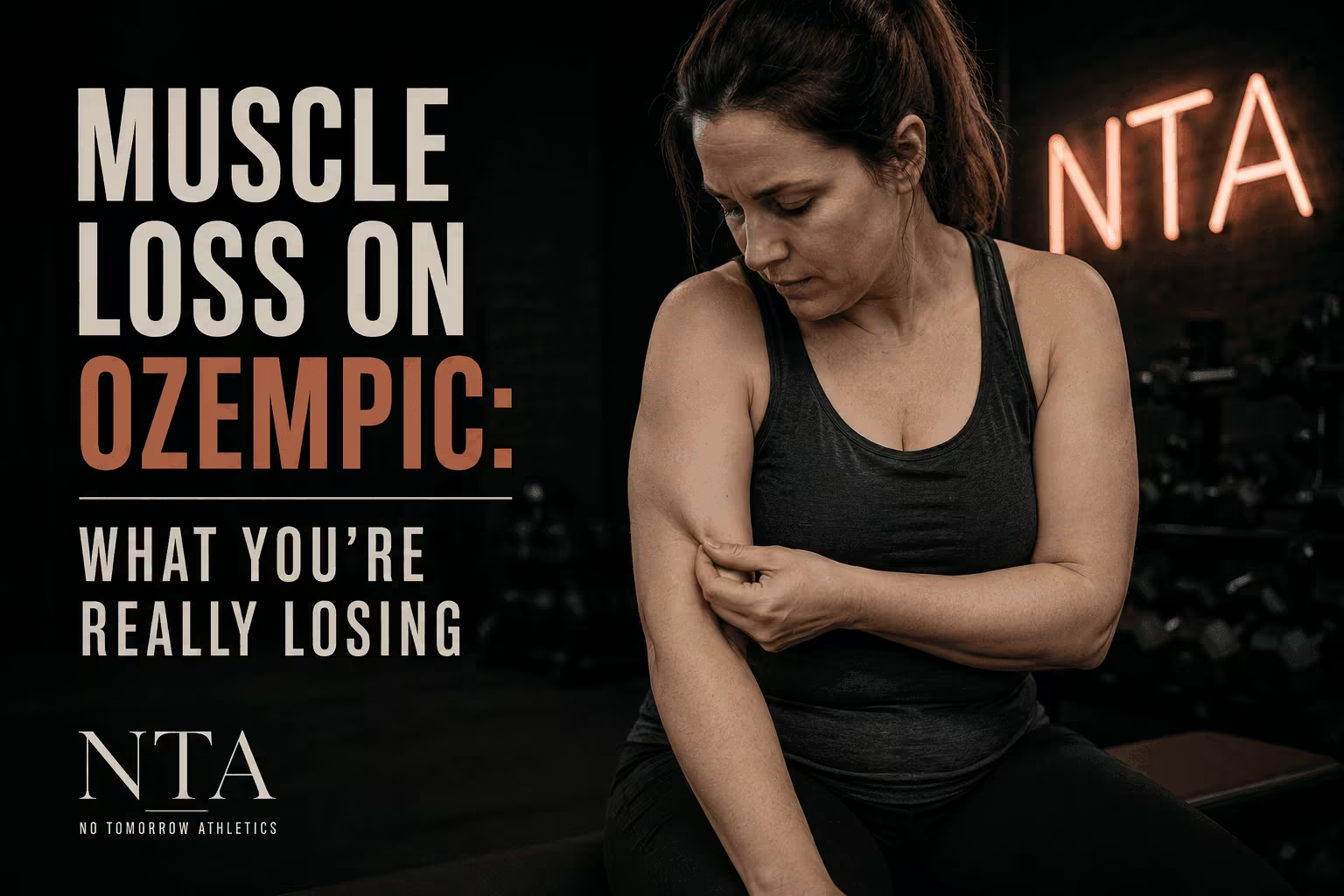
The number on the scale went down. But a number on a scale does not tell you what went down with it.
Muscle loss on Ozempic is one of the most clinically significant and least discussed consequences of GLP-1 receptor agonist therapy. A 2023 analysis published in Obesity found that patients on semaglutide without structured exercise lost an average of 39% of their total weight loss as lean mass over 68 weeks.1 On a 30-pound loss, that means 10 to 12 pounds of muscle — not fat. And that distinction carries consequences that most patients are not warned about before they start.
Understanding what is actually being lost, and why it matters beyond the scale, is the starting point for using GLP-1 medications correctly.
Why Muscle Loss Is a Metabolic Problem, Not Just an Aesthetic One
Skeletal muscle is not just the tissue that moves you. It is metabolically active in ways most people underestimate. Each pound burns approximately 6 calories per day at rest.2 That number sounds modest in isolation, but it compounds. Lose 10 pounds of muscle and your resting metabolic rate — the number of calories your body burns at baseline, doing nothing — drops by roughly 60 calories per day. Lose 12 pounds and the deficit is 72 calories daily. Over a year, that accumulates to more than 25,000 calories of reduced metabolic capacity, built permanently into your physiology until the tissue is rebuilt.
This matters most in the period after GLP-1 therapy ends, or when appetite adaptation occurs mid-cycle. The medication suppresses appetite while it is active. When patients stop, hunger returns. But the metabolic rate they return to is not the same one they started with. It is lower, because the tissue that drove it has been reduced. In that environment, fat regain is not a question of discipline. It is a predictable physiological consequence of a compromised metabolic baseline.
Clinicians call this sarcopenic obesity — the simultaneous loss of lean mass and retention or regain of fat mass. It is not a rare or extreme outcome. It is what happens when aggressive weight loss proceeds without a parallel stimulus to defend muscle tissue.3 Research consistently shows that patients with sarcopenic obesity carry higher rates of metabolic dysfunction, insulin resistance, and long-term physical decline than patients who are simply overweight.4 The GLP-1 boom is creating a new population at risk for exactly this — people who lost significant weight, improved their biometrics, and walked away with a worse metabolic foundation than they started with.
When Muscle Loss Becomes Clinically Significant
Muscle catabolism in a sustained caloric deficit begins within the first weeks of that deficit. The body does not distinguish between pharmacologically induced appetite suppression and voluntary caloric restriction. It reads an energy shortage and responds accordingly, drawing on both fat and protein stores for fuel. Without a resistance training stimulus signaling that muscle tissue is actively necessary, there is no physiological reason to prioritize its preservation.
By weeks 12 to 16, meaningful lean mass losses are measurable in untrained individuals maintaining sustained deficits.5 By 68 weeks — the duration of the semaglutide trial referenced above — the cumulative loss reaches 10 to 12 pounds for patients who do not train. That is not a footnote. Rebuilding that amount of muscle under normal training conditions takes most adults two to four years of consistent progressive resistance work. The loss is fast. Recovery is not linear, and it does not accelerate simply because the original deficit was pharmacologically accelerated.
There is also a compounding quality to this problem that rarely gets discussed. Muscle loss suppresses metabolic rate, which suppresses the rate of fat loss, which often leads patients or clinicians to deepen the caloric deficit — which accelerates muscle loss further. The medication may still be working on appetite. The body composition outcome is quietly getting worse.
What the Same 68 Weeks Looks Like With Resistance Training
The intervention is not complicated, but the outcomes are meaningfully different. Meta-analytic data on resistance training during caloric restriction consistently shows that trained individuals preserve 85 to 95% of their lean mass in a deficit, compared to 60 to 70% for those who do not train.6 Fat loss remains largely intact. What changes is what you are left with after it — a body that has shed fat without dismantling the metabolic machinery that manages body composition long-term.
Some research suggests that patients on GLP-1 therapy who combine the medication with structured resistance training achieve superior body composition outcomes overall: more fat lost relative to lean mass, not simply more total weight lost.7 The mechanism is direct. The training stimulus tells the body that muscle tissue is being used and must be maintained. The medication creates the caloric deficit. Together they produce something neither achieves alone — weight loss that is predominantly fat, with a resting metabolic rate that remains largely intact through and after the medication cycle.
The scale may move more slowly in this scenario. That is not a problem. It is evidence that the right tissues are being lost. A slower total number with a better composition is a superior outcome in every way that matters past the first six months.
The Protein Problem That Makes This Worse
GLP-1 medications suppress appetite broadly — including the appetite for protein. Most patients on these medications are significantly under-eating protein, not because they are making poor choices, but because they are simply not hungry enough to hit their targets. At the same time, a sustained caloric deficit increases anabolic resistance — the body's ability to convert protein into muscle tissue becomes less efficient, meaning higher intake is required to produce the same anabolic response.8
The result is a dual problem: patients on GLP-1 therapy are eating less protein than they need while simultaneously needing more of it than usual. Current evidence suggests protein requirements for individuals in a caloric deficit with a resistance training stimulus may be as high as 2.0 to 2.4 grams per kilogram of body weight — significantly above the general adult recommendation of 1.2 to 1.6 grams per kilogram.9 Hitting that target on a suppressed appetite requires deliberate strategy: high-density protein sources, timing protein intake around training sessions, and a daily structure that reaches adequate intake on significantly reduced overall calories.
How the No Tomorrow Method Addresses This
The Strength pillar of the No Tomorrow Method centers on compound, progressively loaded resistance training — deadlifts, squats, presses, rows. Movements that recruit large muscle groups under meaningful load and send an unambiguous physiological signal: this tissue is in use and must be preserved. The goal is not aesthetics, though aesthetics often follow from sustained training. The goal is the mechanical and metabolic signal itself — the cue that tells the body that weight loss does not have to mean muscle loss.
Clients at No Tomorrow Athletics who are on GLP-1 medications train within the same methodological framework as everyone else. Programming accounts for reduced energy availability and the recovery tolerance changes that accompany this therapy — both of which are real and require adjustment. The training stimulus does not change, because the stimulus is the point. A lower training frequency or modified session volume may be appropriate during the early phase of GLP-1 use. The movement patterns and progressive overload principles remain constant.
GLP-1 medications are a legitimate clinical tool with a well-documented evidence base. The question is not whether to use them. The question is what the weight is made of when you finish the cycle, and what the body you live in afterward is capable of. Without resistance training, the evidence is consistent: a significant portion of what you lose is muscle, your resting metabolic rate declines in direct proportion, and the physiological conditions for fat regain are established before the medication ends. With structured training, that outcome changes. Lean mass is preserved. Metabolic rate is protected. The weight loss holds, because the system that manages body composition is still functioning at the level you built it to.
For a full look at how the No Tomorrow Method integrates strength, conditioning, and mobility into a single system, see our methodology overview. If you are on semaglutide or a similar medication and not resistance training, this is the framework built to address exactly what is missing from your protocol.
Sources
- Wilding JPH, Batterham RL, Calanna S, Davies M, Van Gaal LF, Lingvay I, McGowan BM, Rosenstock J, Tran MTD, Wadden TA, Wharton S, Yokote K, Zeuthen N, Kushner RF; STEP 1 Study Group. Once-Weekly Semaglutide in Adults with Overweight or Obesity. New England Journal of Medicine, 2021.
- Wang Z, Ying Z, Bosy-Westphal A, Zhang J, Schautz B, Later W, Heymsfield SB, Müller MJ. Specific Metabolic Rates of Major Organs and Tissues Across Adulthood: Evaluation by Mechanistic Model of Resting Energy Expenditure. American Journal of Clinical Nutrition, 2010.
- Batsis JA, Villareal DT. Sarcopenic Obesity in Older Adults: Aetiology, Epidemiology and Treatment Strategies. Nature Reviews Endocrinology, 2018.
- Donini LM, Busetto L, Bischoff SC, Cederholm T, Ballesteros-Pomar MD, Batsis JA, Bauer JM, Boirie Y, Cruz-Jentoft AJ, Dicker D, et al. Definition and Diagnostic Criteria for Sarcopenic Obesity: ESPEN and EASO Consensus Statement. Clinical Nutrition, 2022.
- Stokes T, Hector AJ, Morton RW, McGlory C, Phillips SM. Recent Perspectives Regarding the Role of Dietary Protein for the Promotion of Muscle Hypertrophy with Resistance Exercise Training. Nutrients, 2018.
- Bellicha A, van Baak MA, Battista F, Beaulieu K, Blundell JE, Busetto L, et al. Effect of Exercise Training on Weight Loss, Body Composition Changes, and Weight Maintenance in Adults with Overweight or Obesity: An Overview of 12 Systematic Reviews and 149 Studies. Obesity Reviews, 2021.
- Mechanick JI, Butsch WS, Christensen SM, Hamdy O, Li Z, Prado CM, Kushner RF, Gupta AK. Strategies for Minimizing Muscle Loss During Use of Incretin-Mimetic Drugs for Treatment of Obesity. Obesity Reviews, 2025.
Frequently Asked Questions
About the author