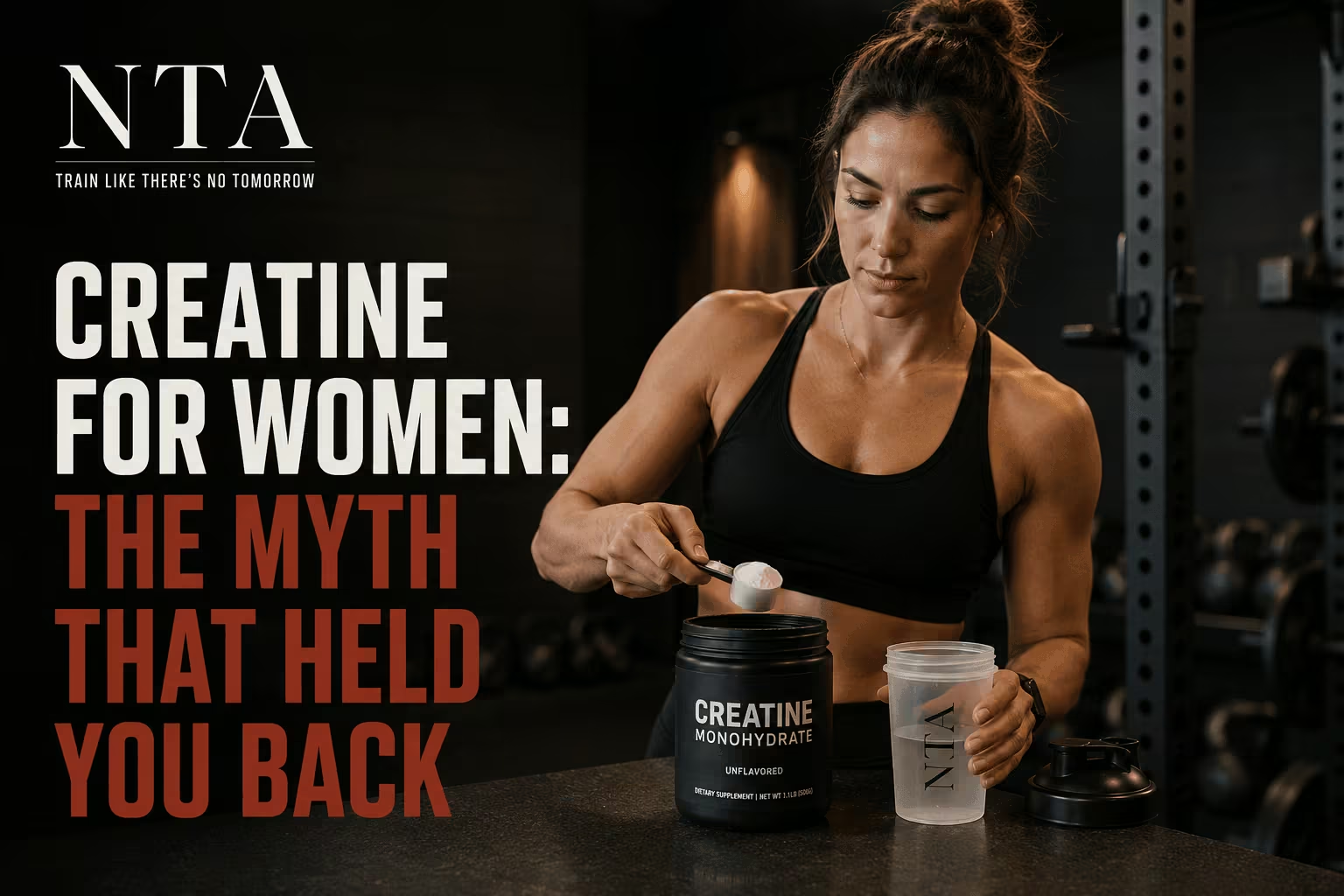
Women were excluded from the majority of early creatine research. A 2021 review published in Nutrients found that women represented fewer than 20 percent of participants across decades of creatine supplementation studies 1. The result was a supplement shaped almost entirely by male physiology, marketed almost entirely to men, and avoided almost entirely by women based on concerns the research never supported in the first place.
That is starting to change. The evidence base for creatine in women has grown significantly over the last five years, particularly around three areas that matter most as women age: muscle mass, bone mineral density, and cognitive function. The bloating fear that kept so many women away from this supplement deserves a direct answer. So does the question of why creatine may be more important for women than the fitness industry ever let on.
Where the Bloating Myth Came From
Creatine is not a hormone, a stimulant, or a fat burner. It is a compound the body produces naturally from amino acids, stored primarily in skeletal muscle as phosphocreatine, and used to regenerate ATP during high-intensity effort. When you supplement it, muscle cells draw in water alongside the creatine — because phosphocreatine storage is water-dependent.
That intramuscular water retention is real. It is also not what most people mean when they say bloating.
The bloating concern comes almost entirely from loading protocols: taking 20 to 25 grams per day for five to seven days to rapidly saturate muscle stores. At those doses, some people experience gastrointestinal discomfort and transient water retention that shows up on the scale in the first week. That is where the reputation came from. And for decades, loading was how creatine was sold and used — which meant the side effects of an aggressive protocol became associated with the supplement itself.
At a standard daily dose of 3 to 5 grams, neither the GI symptoms nor the scale shift are consistent findings in the research 2. Muscle saturation happens more slowly — typically over three to four weeks rather than one — but it happens, and without the acute water retention that accompanies loading. If the bloating concern has been the barrier, skipping the load is the simple, evidence-supported answer.
What Creatine Actually Does for Muscle in Women
Creatine's mechanism is straightforward: by increasing phosphocreatine availability in muscle, it allows you to do more work before fatigue sets in. More total work, repeated over weeks and months of progressive training, produces more muscle. That is the chain. Creatine does not build muscle by itself. It lets training work harder.
For women, this matters for a specific reason. Women have lower baseline creatine stores than men — roughly 70 to 80 percent of male levels — which means the relative benefit of supplementation may actually be greater 1. A 2021 review in the Journal of Strength and Conditioning Research found that creatine supplementation combined with resistance training produced significantly greater gains in lean mass and upper body strength in women compared to placebo, with effect sizes comparable to or exceeding those seen in men 3.
The implications go well beyond aesthetics. Muscle mass is one of the strongest predictors of metabolic health, insulin sensitivity, and functional independence as women age. Building and maintaining it through progressive resistance training is exactly what the Strength pillar at No Tomorrow Athletics is built around, and creatine supports that work directly, at the physiological level where it counts.
Bone Density: The Case That Doesn't Get Enough Attention
The connection between creatine and bone is less well-known than the muscle story, but the evidence is accumulating and the mechanism makes sense. Bone remodeling is driven partly by mechanical loading and partly by the cellular energy available to support that loading. Osteoblasts — the cells responsible for building new bone — rely on ATP, and creatine increases the phosphocreatine pool available to support their activity.
A 2022 randomized controlled trial published in Medicine and Science in Sports and Exercise found that postmenopausal women who supplemented with creatine during a supervised resistance training program showed significantly greater improvements in femoral neck bone mineral density compared to placebo, alongside greater improvements in muscle strength 4. The training did the work. Creatine supported the energy system doing it.
This is particularly relevant for women navigating perimenopause and menopause, when estrogen decline accelerates bone turnover and increases fracture risk. Resistance training is already the most evidence-backed intervention for preserving bone density through this transition — something covered in depth in the NTA posts on strength training for menopause and strength training for bone density. Creatine, layered onto that training, may amplify the skeletal adaptation that training produces. The evidence is not yet definitive on bone, but it is consistent enough that ignoring it would be a mistake.
The Cognitive Angle, Especially Through Menopause
This is the part of the creatine story that most women have never heard, and it may be the most important.
The brain runs on energy. Neurons depend on ATP, and phosphocreatine serves as a rapid buffer for cerebral energy demands during cognitive stress. Creatine crosses the blood-brain barrier, and brain creatine levels are associated with working memory, processing speed, and resistance to mental fatigue 5.
A 2023 meta-analysis in Nutrients found that creatine supplementation improved measures of memory and cognitive performance, with the largest effects seen in contexts of sleep deprivation, mental fatigue, and aging 5. Those are not abstract scenarios. They describe the lived experience of perimenopause for a large number of women.
Estrogen supports brain energy metabolism. As estrogen declines through the menopausal transition, some women experience cognitive symptoms — brain fog, word retrieval difficulty, memory gaps — that are not imagined and not simply a consequence of poor sleep, though poor sleep compounds them. The mechanism linking estrogen to cerebral glucose metabolism is well-documented 6. What is emerging is the possibility that creatine may partially compensate for the energy deficit that estrogen decline creates in the brain.
The research is early. No one is claiming creatine prevents or treats cognitive decline. But the mechanism is plausible, the safety profile is established, and the potential upside during a period when women are already navigating significant neurological change is worth taking seriously.
How to Take It: A Simple, Evidence-Based Protocol
Creatine monohydrate is the form with the most research behind it. There is no convincing evidence that more expensive forms — creatine HCl, buffered creatine, creatine ethyl ester — outperform it at equivalent doses. Start with monohydrate.
Skip the loading phase. The evidence supports getting to full muscle saturation at 3 to 5 grams per day, it just takes three to four weeks instead of one. Unless you are two weeks out from a competition and need to compress the timeline, there is no practical reason to load. Take 3 grams daily if you are under 130 pounds; 5 grams if you are over. Some research in older women and those specifically targeting cognitive or bone outcomes has used doses up to 5 grams, which is well within the established safety range 4.
Timing is largely irrelevant. The research does not support a meaningful difference between pre-training, post-training, or morning supplementation for women at maintenance doses 2. What the research does support is consistency. Daily use builds and maintains muscle saturation. Sporadic use does not.
Mix it into water, coffee, or whatever you are already drinking. It dissolves readily and is tasteless. There is no meaningful reason to use a creatine product that bundles it with stimulants, sweeteners, or additional compounds unless you specifically want those things.
For everything else about how creatine works at the mechanistic level — phosphocreatine, ATP regeneration, why it matters across different training modalities — check out our deep dive on Creatine.
The supplement most likely to help women through perimenopause is the one they were told was for guys trying to get big. That story was wrong. The evidence has been accumulating for years. Three to five grams of creatine monohydrate daily, on top of the resistance training you are already doing, is one of the most straightforward performance and longevity decisions available to you right now.
Sources
- Smith-Ryan, Abbie E., et al. "Creatine Supplementation in Women's Health: A Lifespan Perspective." Nutrients, vol. 13, no. 3, 2021, p. 877.
- Lanhers, Charlotte, et al. "Creatine Supplementation and Lower Limb Strength Performance: A Systematic Review and Meta-Analyses." Sports Medicine, vol. 45, no. 9, 2015, pp. 1285–1294.
- Vandenberghe, K., et al. "Long-Term Creatine Intake Is Beneficial to Muscle Performance During Resistance Training." Journal of Applied Physiology, vol. 83, no. 6, 1997, pp. 2055–2063.
- Chilibeck, Philip D., et al. "Effects of Creatine and Resistance Training on Bone Health in Postmenopausal Women." Medicine and Science in Sports and Exercise, vol. 47, no. 8, 2015, pp. 1587–1595.
- Sandkühler, Julia F., et al. "The Effects of Creatine Supplementation on Cognitive Performance: A Randomised Controlled Study." BMC Medicine, vol. 21, 2023, p. 440.
- Rettberg, Jamaica R., et al. "Estrogen: A Master Regulator of Bioenergetic Systems in the Brain and Body." Frontiers in Neuroendocrinology, vol. 35, no. 1, 2014, pp. 8–30.
Frequently Asked Questions
About the author

.avif)