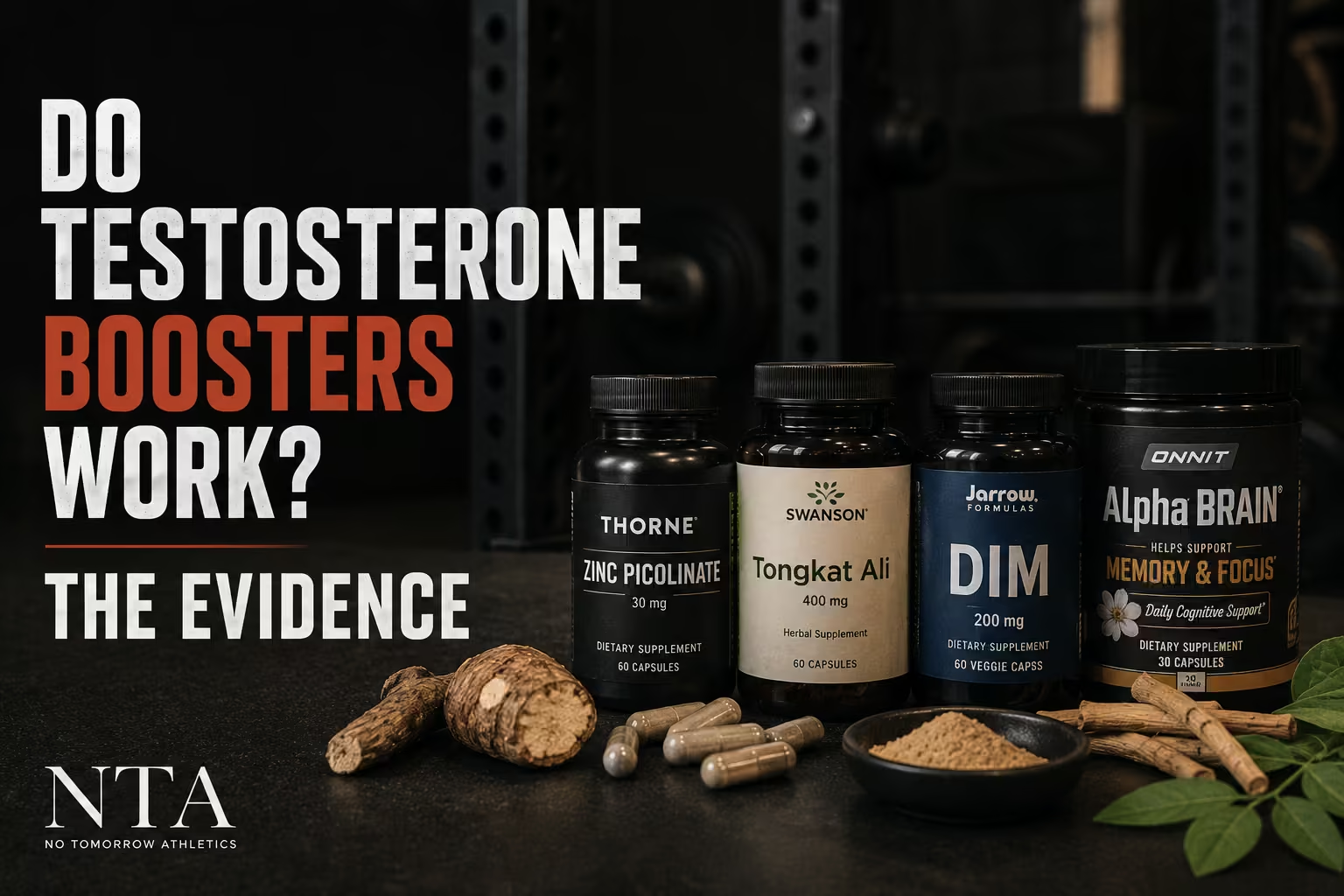
The testosterone booster supplement market generated over $1.5 billion in global sales in 2023, and that number is still growing 1. The men buying these products are not naive. They are doing what makes sense: researching a problem, identifying a possible solution, and putting money behind it. This post respects that instinct by answering the question honestly.
Do testosterone boosters work? For the vast majority of men buying them, no. Not in any meaningful way. But the more useful answer requires understanding exactly why, ingredient by ingredient, because the nuance is where the marketing lives.
Why the Category Exists in the First Place
Testosterone declines gradually after age 30, at roughly 1 to 2 percent per year 2. For most men, that decline is slow enough that it never becomes clinically significant. But the awareness of it is enough to sustain a billion-dollar industry, because the decline is real and the symptoms of low testosterone, such as reduced energy, diminished drive, slower recovery, and changes in body composition, are also real.
The problem is not that men want to address testosterone. The problem is that the products marketed to address it work almost exclusively by exploiting a specific scientific truth and applying it where it does not belong. That truth is this: correcting a genuine deficiency in a deficient person can restore normal testosterone production. What the marketing omits is the second half of that sentence. Supplementing above sufficiency does not push testosterone higher. That gap is where the entire booster category hides.
The Most Common Ingredients, Evaluated Honestly
Vitamin D
This is the ingredient with the most legitimate science behind it, and also the most commonly misapplied. Vitamin D deficiency, defined as serum levels below 20 ng/mL, is associated with lower testosterone levels 3. Correcting that deficiency in a deficient man does appear to support normal testosterone production. One 12-month randomized controlled trial found that men who supplemented with 3,332 IU of vitamin D daily had significantly higher testosterone levels than the placebo group 3. The catch is that the study population was deficient to begin with. If your vitamin D is already sufficient, supplementing more does not raise your testosterone further. It does nothing. Without a blood test to confirm your actual level, you have no idea whether you are in the group this research applies to.
Zinc
Same principle applies. Zinc deficiency is genuinely associated with reduced testosterone and impaired reproductive function, and restoring adequate zinc in a deficient man can normalize production 4. Most men eating a reasonably protein-sufficient diet, particularly one including red meat or shellfish, are not zinc deficient. For those men, additional zinc supplementation adds no measurable testosterone benefit and at high doses begins to interfere with copper absorption 4. This is a nutrient worth confirming, not blindly adding.
Ashwagandha
Ashwagandha (Withania somnifera) has the most published human trial data of any herbal ingredient in this category. Some trials do report increases in testosterone, but read them carefully. The most cited studies enrolled men under chronic psychological stress or men with fertility issues, not healthy recreational athletes 5. A 2019 randomized controlled trial in resistance-trained men showed a modest increase in testosterone compared to placebo, but the effect size was small and the study was short at 8 weeks 5. The evidence is inconsistent across populations, and no long-term data exists. Ashwagandha may have real value as an adaptogen for stress management. Its testosterone effects in already-healthy men are not well established.
Fenugreek
Fenugreek is common in proprietary blends. A few small studies have shown increases in free testosterone, but the mechanism is not direct hormone production. Fenugreek appears to inhibit aromatase, the enzyme that converts testosterone to estrogen, and may also inhibit 5-alpha reductase 6. If there is an effect, it is on conversion pathways, not production. The studies are short, small, and often industry-funded. This is an ingredient that needs better independent research before any firm conclusion is warranted.
Everything Else in the Blend
Most testosterone booster proprietary blends contain six to twelve ingredients including tribulus terrestris, maca root, boron, D-aspartic acid, and various herbal extracts. Tribulus terrestris has been studied extensively and has not demonstrated reliable testosterone elevation in healthy men in multiple independent trials 7. D-aspartic acid showed early promise in one small study but subsequent larger trials in trained men found no effect 8. Boron has minimal human trial data. The multi-ingredient proprietary blend as a commercial product has essentially no independent clinical validation as a category.
The Testing Argument They Use, and Why It Cuts Both Ways
Some companies will point to before-and-after testosterone tests in their marketing. Here is what to understand about that. Testosterone is not a stable number. It varies by time of day, sleep quality the prior night, recent exercise, stress, and the individual lab running the assay 2. A test taken at 8 AM after a good night of sleep will read meaningfully higher than one taken at 3 PM after a rough week. Morning total testosterone can be 20 to 35 percent higher than an afternoon reading in the same individual 2. Before-and-after comparisons in marketing materials do not control for any of this. The number went up. Whether the supplement caused it is a different question entirely.
What the Evidence Actually Supports
If the goal is optimizing testosterone over the long term, the interventions with the most consistent evidence are not in a capsule.
Resistance training is the most reliable acute and chronic testosterone stimulus available. Compound movements at meaningful loads, performed consistently over weeks and months, produce measurable hormonal adaptations 9. The No Tomorrow Method is built on this. Strength training is not a lifestyle add-on; it is a physiological intervention.
Sleep is the other major lever most men underestimate. One week of sleeping under six hours per night reduces testosterone by up to 15 percent in healthy young men 10. That is not a small effect. No supplement in this category produces a 15 percent reduction, or restoration, in the other direction. If a man is sleeping six hours and spending forty dollars a month on testosterone boosters, the math on where his effort belongs is clear.
Body composition matters too. Adipose tissue contains aromatase, the enzyme that converts testosterone to estrogen. Higher body fat is consistently associated with lower testosterone and higher estrogen in men 9. Reducing excess body fat through real training and real nutrition is a meaningful hormonal intervention. It is not fast, but it compounds.
Get blood work done. A basic hormone panel that includes total testosterone, free testosterone, SHBG, and vitamin D costs under a hundred dollars at most labs and tells you whether there is actually something to address. If your testosterone is genuinely low, that is a conversation for a physician, not a supplement stack. If your vitamin D is deficient, correct it with a known dose under guidance. Act on real data, not marketing language.
The principle behind all of this is one No Tomorrow Athletics applies to every aspect of training: build the foundation correctly and the adaptation follows. There are no reliable shortcuts in the testosterone booster category, just as there are no reliable shortcuts in the weight room. The intervention that works is the one you can repeat, sustain, and build on.
If you want the complete picture on supporting testosterone naturally, including training variables, sleep protocols, and nutrition targets, see our guide to natural testosterone optimization. The research there goes deeper on the lifestyle levers worth your actual attention.
Sources
- Grand View Research. Testosterone Booster Supplements Market Size Report. Grand View Research, 2023.
- Brambilla DJ, O'Donnell AB, Matsumoto AM, McKinlay JB. Intraindividual Variation in Levels of Serum Testosterone and Other Reproductive and Adrenal Hormones in Men. Clinical Endocrinology, 2007.
- Pilz S, Frisch S, Koertke H, Kuhn J, Dreier J, Obermayer-Pietsch B, Wehr E, Zittermann A. Effect of Vitamin D Supplementation on Testosterone Levels in Men. Hormone and Metabolic Research, 2011.
- Prasad AS, Mantzoros CS, Beck FW, Hess JW, Brewer GJ. Zinc Status and Serum Testosterone Levels of Healthy Adults. Nutrition, 1996.
- Wankhede S, Langade D, Joshi K, Sinha SR, Bhattacharyya S. Examining the Effect of Withania Somnifera Supplementation on Muscle Strength and Recovery: A Randomized Controlled Trial. Journal of the International Society of Sports Nutrition, 2015.
- Wilborn C, Taylor L, Poole C, Foster C, Willoughby D, Kreider R. Effects of a Purported Aromatase and 5α-Reductase Inhibitor on Hormone Profiles in College-Age Men. International Journal of Sport Nutrition and Exercise Metabolism, 2010.
- Neychev VK, Mitev VI. The Aphrodisiac Herb Tribulus Terrestris Does Not Influence the Androgen Production in Young Men. Journal of Ethnopharmacology, 2005.
- Melville GW, Siegler JC, Marshall PWM. Three and Six Grams Supplementation of D-Aspartic Acid in Resistance Trained Men. Journal of the International Society of Sports Nutrition, 2015.
- Vingren JL, Kraemer WJ, Ratamess NA, Anderson JM, Volek JS, Maresh CM. Testosterone Physiology in Resistance Exercise and Training. Sports Medicine, 2010.
- Leproult R, Van Cauter E. Effect of 1 Week of Sleep Restriction on Testosterone Levels in Young Healthy Men. JAMA, 2011.
Frequently Asked Questions
About the author
.avif)