
One week of sleeping fewer than six hours per night reduces testosterone by up to 15% in healthy young men 1. No injury required. No diagnosis required. Just a week of bad sleep.
That number matters because it reframes the conversation. Most men who feel the symptoms of low testosterone — flat energy, poor recovery, declining strength, disrupted mood — have not had their labs checked. And many who have had their labs checked assume the answer lives in a clinic. Often, it doesn't. The most common causes of suppressed natural testosterone are modifiable lifestyle factors, and they compound each other in ways that make the effect feel systemic even when the fix is behavioral.
This post covers the five primary suppressors, the mechanism behind each, and the specific targets worth aiming for. Training, sleep, and stress all move this number in ways most people underestimate — that's covered in depth here if you want to see how they connect. This piece is about what's pulling the number down right now and what to do about it.
Sleep Is When Testosterone Gets Made
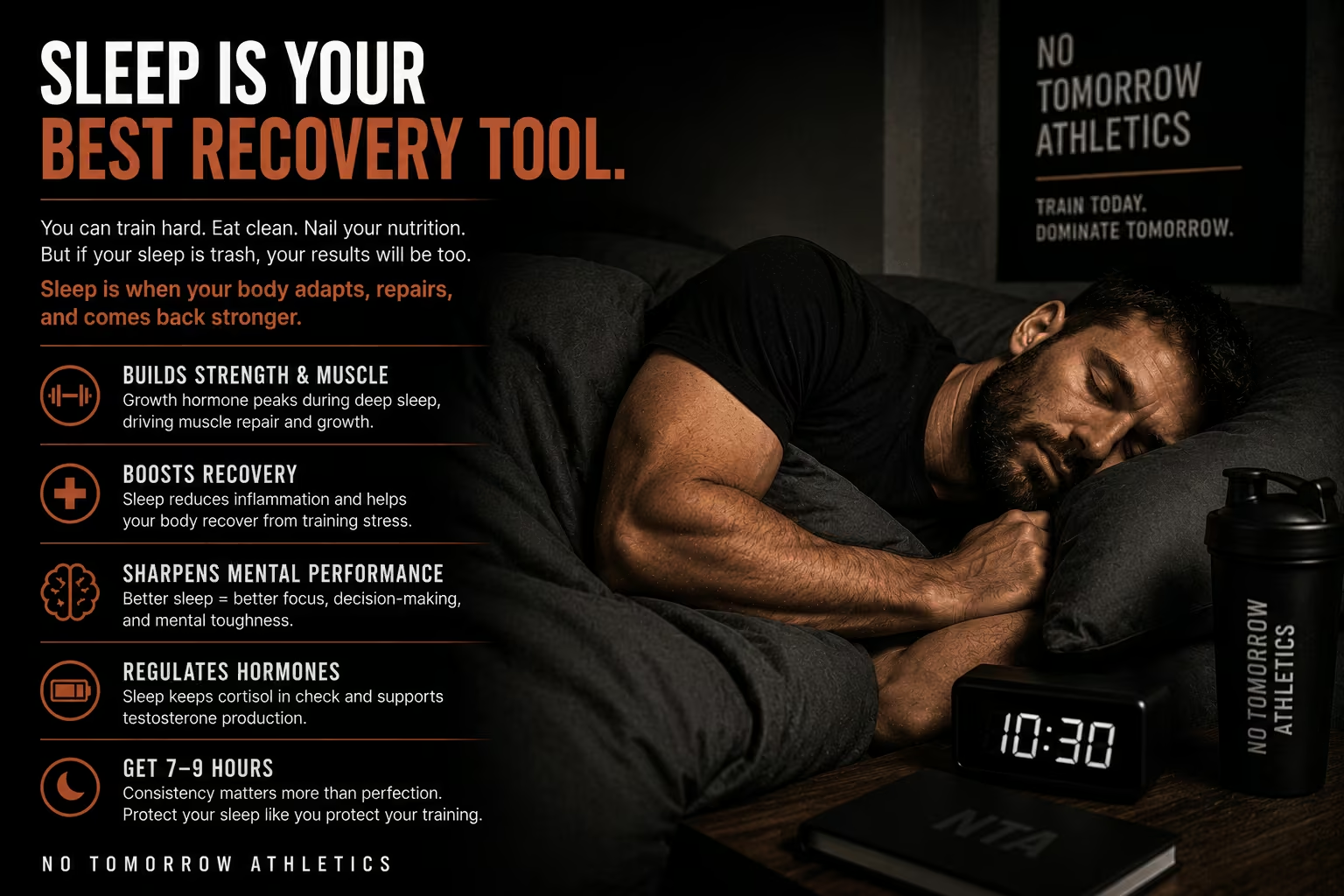
The majority of daily testosterone release occurs during sleep, concentrated in the early hours of the night and tied to slow-wave sleep cycles 2. This is not a passive process. It is production. When you cut sleep short, you cut production short.
The 2011 University of Chicago study that produced the 15% figure did not use extreme sleep deprivation 1. It used a restriction to five hours per night for one week — a schedule that millions of men would call a normal work week. Testosterone levels in participants dropped measurably by day three and continued declining. The suppression was not subtle.
The target is seven to nine hours per night, with consistency in sleep and wake times carrying nearly as much weight as total duration 3. Irregular sleep schedules disrupt circadian rhythm, which disrupts the hormonal signaling that drives nighttime testosterone release. A Friday night that runs until 1 AM costs more than one night. It shifts the entire week's rhythm.
The most important intervention for testosterone is also the most boring one. Go to bed at the same time. Get eight hours. Do this most nights.
Body Fat Converts Testosterone Into Estrogen
Adipose tissue — body fat — contains aromatase, an enzyme that converts testosterone into estradiol, a form of estrogen 4. The more body fat you carry, particularly visceral fat concentrated around the midsection, the higher your aromatase activity. The higher your aromatase activity, the more of your circulating testosterone gets converted before it can do its job.
This is not about aesthetics. It is about endocrine function. Men with obesity consistently show lower total and free testosterone levels alongside elevated estrogen 5. The relationship is bidirectional — low testosterone makes fat loss harder, which increases aromatization, which lowers testosterone further. The cycle reinforces itself.
The prescription here is not a body fat percentage to chase. It is directional: reducing excess body fat, particularly visceral fat, through consistent training and sustainable nutrition will reduce aromatase activity and improve the testosterone-to-estrogen ratio. The training approach matters too. Resistance training and high-intensity conditioning both support testosterone more effectively than steady-state cardio alone 6.
Alcohol Suppresses the Signal and Slows the Clearance
Chronic alcohol intake suppresses testosterone through two distinct mechanisms, and understanding both explains why the effect is more significant than most men expect.
First, alcohol is directly toxic to the Leydig cells in the testes — the cells responsible for producing testosterone 7. Regular heavy drinking reduces their output at the source. Second, alcohol impairs the liver's ability to metabolize estrogen. When estrogen clearance slows, circulating estrogen rises, which feeds back negatively on the hypothalamic-pituitary axis and further suppresses testosterone production.
The research on moderate drinking is more nuanced, but the honest summary is this: regular alcohol use, even below the threshold of clinical heavy drinking, creates a hormonal environment that is consistently less favorable for testosterone production and recovery 8. If your goal is to optimize natural testosterone, alcohol is not neutral.
This is not an argument for total abstinence. It is an argument for honesty about trade-offs. A drink or two on occasion is a different physiological input than four nights a week of three drinks. Most men, when they actually track it, find they are closer to the latter than they thought.
Overtraining Tells Your Body to Stop Producing
Training is a stressor. The right amount of stress produces adaptation. Too much, without adequate recovery, produces suppression.
Chronically elevated cortisol is the mechanism. Hard training raises cortisol, which is appropriate and necessary in the short term. But when training volume stays high and recovery stays insufficient, cortisol does not return to baseline. It stays elevated. And elevated cortisol directly suppresses the hypothalamic-pituitary-gonadal axis — the hormonal cascade that begins in the brain and ends in testosterone production 9. The body reads chronic high cortisol as a survival signal. It down-regulates reproduction and anabolism in favor of stress response.
The symptoms of overtraining-driven testosterone suppression overlap heavily with the symptoms of overtraining itself: persistent fatigue, declining performance, disrupted sleep, flat mood, reduced motivation to train. Most athletes who experience this push harder in response. That is the wrong direction.
At No Tomorrow Athletics, the No Tomorrow Method is built around this reality. The conditioning and mobility pillars exist alongside strength work not as add-ons, but as structural elements that allow higher training outputs without accumulating the kind of systemic stress that drives cortisol chronically upward. Volume is managed deliberately. Recovery is not optional. The goal is a training load your body can absorb and adapt to — not one that keeps you just functional enough to show up.
The practical target is simple to say and harder to execute: more is not better. Enough is better. Enough means the volume you can recover from within 48 to 72 hours, consistently, week over week. If you are not recovering between sessions, you are not training. You are grinding.
Chronic Stress Works the Same Way, Off the Platform
The same cortisol mechanism that suppresses testosterone in overtrained athletes operates identically under chronic psychological stress. Work pressure, poor sleep, financial strain, relationship conflict — the body does not distinguish between the source of a cortisol signal. It responds to the cortisol itself 10.
Research consistently shows that men with chronically elevated psychological stress have lower testosterone levels independent of training status, body composition, and sleep 10. The brain reads sustained threat and down-regulates the hormonal systems associated with growth and reproduction. This is not weakness. It is evolutionary logic operating in a context it was not designed for.
The intervention is not meditation for its own sake, though controlled breathing and deliberate recovery practices do have documented effects on cortisol regulation 11. The more useful frame is this: managing training-related stress and life stress together is the only way to understand your total physiological load. An athlete who trains intelligently but lives in a state of chronic psychological stress is carrying a cortisol burden that undermines the hormonal returns of the training.
At minimum: protect sleep, manage volume, and take recovery as seriously as output. These are not soft recommendations. They are the conditions under which testosterone stays where it belongs.
The Variables You Actually Control
Your testosterone problem is probably not a medical problem. It is a recovery problem, a body composition problem, or a training problem. Those are fixable.
Sleep seven to nine hours, consistently, at consistent times. Move body fat in the right direction through training and sustainable nutrition. Be honest about alcohol and what it costs across a week, not just a night. Train hard enough to adapt, not so hard that you accumulate systemic stress you cannot clear. Manage the cortisol load that comes from outside the gym with the same seriousness you bring to what happens inside it.
None of these interventions require a prescription. They require consistency. The men who feel the most significant shifts in energy, recovery, and performance when they address these factors are usually the ones who had the most room to improve on more than one of them at once. The compounding works in both directions. Fix the suppressors, and the system responds.
Sources
- Leproult R, Van Cauter E. Effect of 1 Week of Sleep Restriction on Testosterone Levels in Young Healthy Men. JAMA, 2011.
- Axelsson J, Ingre M, Akerstedt T, Holmback U. Effects of Acutely Displaced Sleep on Testosterone. Journal of Clinical Endocrinology and Metabolism, 2005.
- Wittert G. The Relationship Between Sleep Disorders and Testosterone in Men. Asian Journal of Andrology, 2014.
- Dutta D, Mohindra R, Kumar M, Sharma M. Role of Aromatase Inhibitors in Managing Hypogonadism in Adult Males Related to Obesity and Aging: A Systematic Review and Meta-Analysis. Indian Journal of Endocrinology and Metabolism, 2022.
- Kelly DM, Jones TH. Testosterone: A Metabolic Hormone in Health and Disease. Journal of Endocrinology, 2013.
- Riachy R, McKinney K, Tuvdendorj DR. Various Factors May Modulate the Effect of Exercise on Testosterone Levels in Men. Journal of Functional Morphology and Kinesiology, 2020.
- Emanuele MA, Emanuele NV. Alcohol's Effects on Male Reproduction. Alcohol Health and Research World, 1998.
- Sierksma A, Sarkola T, Eriksson CJ, van der Gaag MS, Grobbee DE, Hendriks HF. Effect of Moderate Alcohol Consumption on Plasma Dehydroepiandrosterone Sulfate, Testosterone, and Estradiol Levels in Middle-Aged Men and Postmenopausal Women. Alcoholism: Clinical and Experimental Research, 2004.
- Cadegiani FA, Kater CE. Hormonal Aspects of Overtraining Syndrome: A Systematic Review. BMC Sports Science, Medicine and Rehabilitation, 2017.
- Whirledge S, Cidlowski JA. Glucocorticoids, Stress, and Fertility. Minerva Endocrinologica, 2010.
- Pascoe MC, Thompson DR, Jenkins ZM, Ski CF. Mindfulness Mediates the Physiological Markers of Stress: Systematic Review and Meta-Analysis. Journal of Psychiatric Research, 2017.
Frequently Asked Questions
About the author
.avif)
.avif)
.avif)