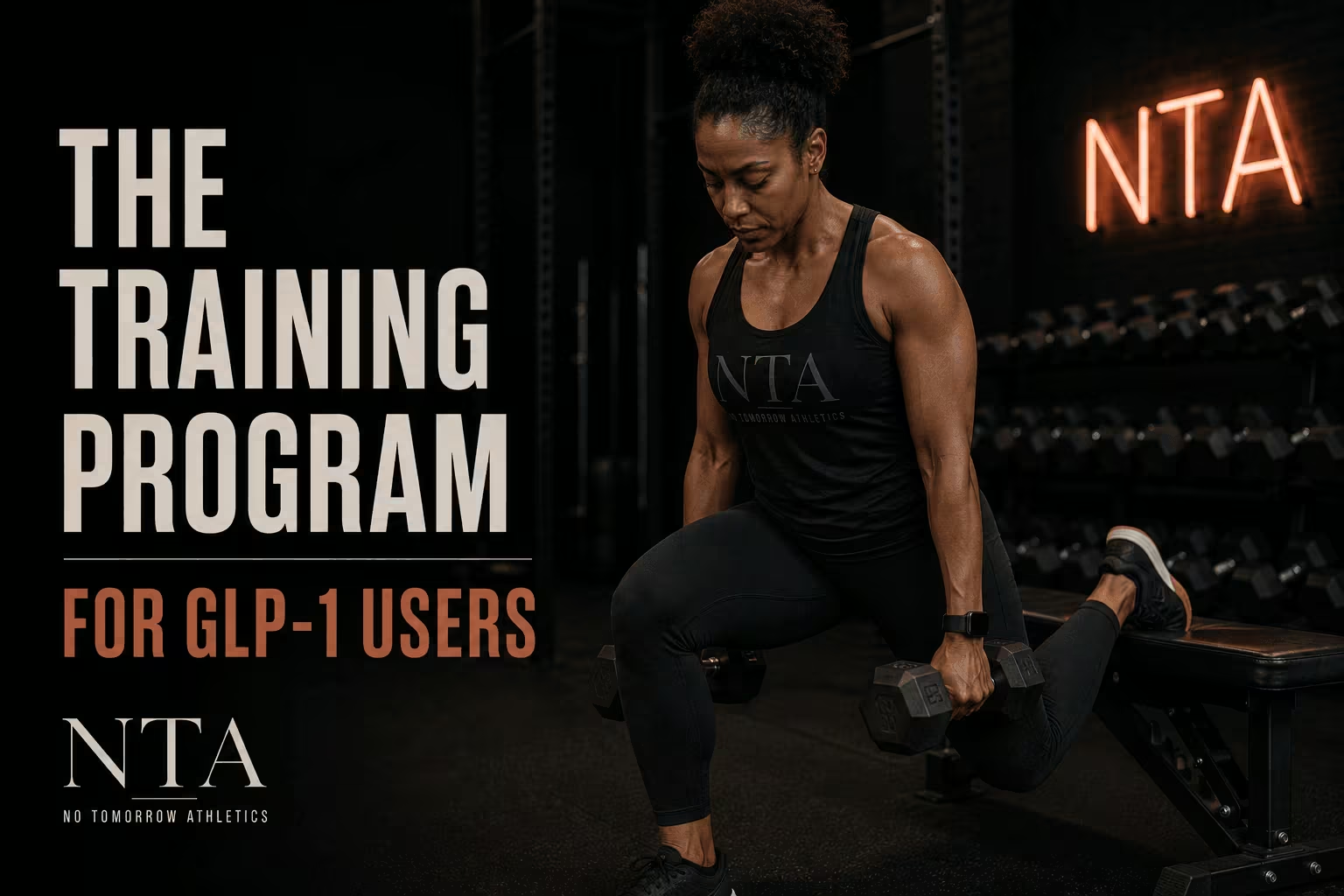
GLP-1 medication will make you lose weight. The question is what kind of weight.
Without a structured exercise program for GLP-1 users, a significant portion of that loss will come from muscle. That is not a hypothetical. It is what the research shows, and it is what we see in practice at No Tomorrow Athletics with clients who come to us after months of medication-only weight loss — lighter on the scale, but softer, weaker, and metabolically worse off than when they started.
This post gives you the exact weekly training structure to make sure that does not happen to you.
Why Resistance Training Changes Everything on GLP-1
A 2024 randomized controlled trial found that GLP-1 users who combined semaglutide with structured resistance training lost 2.3x more fat mass and retained 89% more lean mass compared to GLP-1 users who did aerobic exercise only 1. That is not a marginal difference. That is the difference between a body recomposition and a smaller version of the same problem.
The mechanism matters here. GLP-1 medications create a sustained caloric deficit by suppressing appetite. In a deficit, the body needs a signal to protect muscle tissue. Resistance training provides that signal — specifically, the mechanical tension placed on muscle fibers triggers mTOR pathway activation and elevates muscle protein synthesis, even in a hypocaloric state 2. Without that signal, the body has no reason to preserve lean mass. It will simply take what it needs from wherever is most convenient, and muscle is not exempt.
Aerobic exercise alone does not send this signal with sufficient strength. It may improve cardiovascular health, and it has a role in this program — but if it is your only training modality during a GLP-1 cycle, you are accepting unnecessary lean mass loss. Strength training is a crucial component of your GLP-1 program.
GLP-1 medication handles the deficit. Resistance training decides what fills it.
Managing the Early Weeks — Fatigue, Nausea, and Training Load
Before you look at the weekly structure, you need to understand something about the first four to eight weeks on a GLP-1 medication: your body is adjusting. Nausea, fatigue, and reduced appetite are common early side effects, and they directly affect training capacity 3.
This is not the time to test your one-rep maxes. This is the time to show up consistently at reduced intensity.
Phase 1 — Weeks 1 to 4 (Adaptation Phase)
Drop working weights by 20 to 30 percent from your recent training loads. Keep the movement patterns intact — squat, hinge, push, pull — but treat this phase as skill practice at moderate intensity. The goal is to establish the habit and the stimulus without overtaxing a system that is already under pharmacological stress. Session length should be 35 to 45 minutes. If nausea is significant, train earlier in the day before eating, or wait until a stable window 90 minutes after your smallest meal.
Phase 2 — Weeks 5 to 12 (Progressive Loading Phase)
As your body stabilizes on the medication, begin adding load methodically. Progressive overload — incrementally increasing the demand placed on the muscle over time — is the mechanism by which strength and muscle mass are built and preserved 4. This is not optional. If you are not progressively overloading, you are not providing a strong enough stimulus to protect lean mass. Add five to ten pounds per movement when you can complete your top set with two reps left in reserve.
The Weekly Training Structure for GLP-1 Users
This is the No Tomorrow Method applied directly to the physiological context of a medicated caloric deficit. All three pillars — Strength, Conditioning, and Mobility — are present, and each has a specific role.
Day 1 — Lower Body Resistance (45 to 60 minutes)
The primary stimulus for the week's most demanding compound movements.
- Barbell Back Squat or Goblet Squat — 4 sets of 6 to 8 reps at RPE 7 to 8
- Romanian Deadlift — 3 sets of 8 to 10 reps
- Bulgarian Split Squat — 3 sets of 8 per leg
- Leg Press — 2 sets of 12 to 15 (volume finisher)
- Banded Hamstring Curl — 2 sets of 15
Rest 90 to 120 seconds between compound sets. No supersets in this session — the focus is load and quality.
Day 2 — Zone 2 Cardio (30 to 45 minutes)
Zone 2 training means working at a heart rate between 60 and 70 percent of your maximum — the intensity at which your body primarily oxidizes fat for fuel 5. This supports the fat-loss effect of GLP-1 without generating the cortisol spike that higher-intensity cardio produces in a deficit. Elevated cortisol in a caloric deficit accelerates lean mass loss — the exact outcome you are trying to prevent.
Options: incline treadmill walk, rowing at controlled pace, cycling, or outdoor walking at a brisk pace. You should be able to hold a full conversation. If you cannot, slow down.
Day 3 — Upper Body Resistance (45 to 60 minutes)
- Barbell or Dumbbell Bench Press — 4 sets of 6 to 8 reps at RPE 7 to 8
- Barbell or Cable Row — 4 sets of 8 to 10 reps
- Overhead Press — 3 sets of 8 to 10 reps
- Lat Pulldown — 3 sets of 10 to 12 reps
- Dumbbell Curl and Tricep Pushdown — 2 sets of 12 each (superset)
Pull volume should match or exceed push volume every week. This protects shoulder health and posture — particularly important for athletes spending time in a caloric deficit where soft tissue recovery is slower.
Day 4 — Zone 2 Cardio or Full Rest
Same protocol as Day 2 if energy is adequate. If you are in the first four weeks, or if your current injection dose was recently increased, take full rest. Showing up to a Zone 2 session fatigued does not accelerate fat loss. It adds unnecessary recovery debt.
Day 5 — Full Body Resistance (45 to 60 minutes)
This session links the lower and upper body patterns and is the highest skill-demand session of the week.
- Trap Bar Deadlift or Conventional Deadlift — 4 sets of 5 reps at RPE 7 to 8
- Weighted Pull-Up or Assisted Pull-Up — 3 sets of 6 to 8 reps
- Dumbbell Incline Press — 3 sets of 10 reps
- Dumbbell Reverse Lunge — 3 sets of 8 per leg
- Plank or Dead Bug — 3 sets of 30 to 45 seconds
Day 6 — Active Recovery (Mobility and Walking)
This is not optional. Active recovery accelerates the removal of metabolic waste from training, reduces delayed onset muscle soreness, and maintains range of motion — all of which directly affect how well you perform in the next training week 6. Twenty to thirty minutes of structured mobility work — hip flexors, thoracic spine, hamstrings, ankles — followed by a 20-minute walk. This is the Mobility pillar of the No Tomorrow Method, and in a caloric deficit it carries more importance than most athletes give it.
Day 7 — Full Rest
Full rest. No justification required. Rest is where primary adaptation occurs, and is arguably one of the most important components of your training.
Protein Is the Other Half of This Equation
No training program for GLP-1 users works without adequate protein intake. The research is consistent: protein requirements increase during periods of caloric restriction, with current evidence supporting a minimum of 1.6 grams per kilogram of body weight per day for muscle preservation, and up to 2.2 grams per kilogram for active individuals in a significant deficit 7. GLP-1 medications suppress appetite indiscriminately — meaning protein intake often drops alongside overall calorie intake unless it is tracked and prioritized deliberately.
For a full breakdown of how to hit protein targets while appetite-suppressed, read our post on protein strategy for GLP-1 users [internal: Spoke 2 — protein]. For the complete picture on why muscle loss during GLP-1 cycles is a problem worth taking seriously, start with our hub post on GLP-1 and body composition [internal: hub post] and our breakdown of lean mass loss on semaglutide [internal: Spoke 1 — muscle loss].
What Medication Alone Cannot Do
Semaglutide and tirzepatide are effective tools. They create a caloric environment that most people cannot sustain through willpower alone. But they do not build muscle. They do not teach the body to preferentially oxidize fat. They do not create the neuromuscular adaptations that make you stronger, more resilient, and more metabolically capable at the end of a weight loss cycle than you were at the beginning.
That is what training does. That is what this program does.
At No Tomorrow Athletics, we work with GLP-1 users who want the outcome the medication promises and the physical capacity that only structured training builds. The No Tomorrow Method — Strength, Conditioning, Mobility — was built for exactly this intersection. If you are in Essex County, NJ and you are on a GLP-1 medication without a training program behind it, this is the work that makes the medication worth taking.
Sources
- Tinsley GM, Heymsfield SB. Fundamental Body Composition Principles Provide Context for Fat-Free and Skeletal Muscle Loss with GLP-1 RA Treatments. Journal of the Endocrine Society, 2024.
- Burd NA, Tang JE, Moore DR, Phillips SM. Exercise Training and Protein Metabolism: Influences of Contraction, Protein Intake, and Sex-Based Differences. Journal of Applied Physiology, 2009.
- Rubino DM, Greenway FL, Khalid U, O'Neil PM, Rosenstock J, Sørrig R, Wadden TA, Wizert A, Garvey WT; STEP 8 Investigators. Effect of Weekly Subcutaneous Semaglutide vs Daily Liraglutide on Body Weight in Adults With Overweight or Obesity Without Diabetes: The STEP 8 Randomized Clinical Trial. JAMA, 2022.
- Plotkin DL, Roberts MD, Haun CT, Schoenfeld BJ. Muscle Fiber Type Transitions With Exercise Training: Shifting Perspectives. Sports, 2021.
- Iaia FM, Bangsbo J. Speed Endurance Training Is a Powerful Stimulus for Physiological Adaptations and Performance Improvements of Athletes. Scandinavian Journal of Medicine and Science in Sports, 2010.
- Ortiz RO Jr, Sinclair Elder AJ, Elder CL, Dawes JJ. A Systematic Review on the Effectiveness of Active Recovery Interventions on Athletic Performance of Professional-, Collegiate-, and Competitive-Level Adult Athletes. Journal of Strength and Conditioning Research, 2019.
- Stokes T, Hector AJ, Morton RW, McGlory C, Phillips SM. Recent Perspectives Regarding the Role of Dietary Protein for the Promotion of Muscle Hypertrophy With Resistance Exercise Training. Nutrients, 2018.
Frequently Asked Questions
About the author