Most women expect perimenopause to arrive sometime in their early 50s, packaged with hot flashes and a confirmed shift in their cycle. That expectation is wrong, and it is costing women years of training that they cannot fully recover later.
A 2025 study published in npj Women's Health surveyed over 4,400 U.S. women and found significant perimenopause symptom burden in women as young as 30 to 45 1. Mood symptoms including anxiety and irritability peaked between ages 41 and 45, well before the hot flashes and cycle changes most women associate with the transition. The hormonal disruption starts early. The training response to it needs to start early too.
Perimenopause Is Not a Stable Hormone State
This distinction matters because most training and medical advice around hormonal health is written for menopause, which is a stable, low-estrogen state that responds predictably to a consistent protocol. Perimenopause is not that. It is defined by fluctuating estrogen rather than simply declining estrogen, and those swings — not the eventual low baseline — are often the more physiologically disruptive part of the transition. A program built for the wrong hormonal state is not a program that's slightly off. It is solving for a problem the body isn't actually having yet.
Estrogen oscillates irregularly during perimenopause, and the pattern is not a smooth downward slope. Levels can surge above premenopausal baseline in one cycle, then drop sharply in the next, sometimes within the same month. That unpredictability doesn't stay contained to reproductive function — it reaches into sleep quality, mood regulation, recovery capacity, and the body's ability to respond to a given training stimulus on any particular week. A session that would have produced a predictable adaptation response at 34 can land completely differently at 44, not because the training changed, but because the hormonal environment receiving that training stimulus is a different one from week to week.
Understanding this distinction changes three things in practice: how you train, what you expect from your body, and how you interpret a bad week. A woman who doesn't know this is happening will often read a rough training week — poor sleep, flat energy, a session that felt harder than it should have — as a sign that something is wrong with her program, her effort, or her body. In reality, it may simply be a low-estrogen phase inside a cycle that is no longer following its old predictable pattern. Recognizing that distinction is the difference between adjusting a program that doesn't need adjusting and correctly reading a hormonal fluctuation for what it is.
This is not a condition to manage only once symptoms become severe enough to demand attention. It is a physiological transition with a long lead time, frequently a decade or more, and the training decisions made during that lead time are what determine how much lean tissue, bone density, and metabolic resilience a woman carries into and through menopause itself. Waiting until the transition is confirmed and symptomatic means waiting until some of that ground is already lost. The women who fare best through menopause are, in large part, the ones who were already training seriously years before menopause became the word their doctor used.
Three Mechanisms That Make This Transition a Training Problem
Anabolic Resistance Begins Before You Expect It
Estrogen plays a direct role in anabolic signaling. It supports muscle protein synthesis, enhances the satellite cell response to mechanical loading, and influences the androgen receptor activity that governs muscle tissue repair². When estrogen begins fluctuating and trending downward during perimenopause, muscle tissue becomes measurably less responsive to the same training stimulus that maintained it in the 30s, the same sets, the same loads, the same effort, producing a smaller adaptation than they used to.
Researchers call this anabolic resistance. The training that used to be sufficient to maintain muscle starts under-delivering, not because the woman is doing anything differently, but because the tissue receiving the stimulus is responding to it less efficiently than it once did. A woman who has been moderately active in her 30s may not notice the change immediately, because the decline is gradual and the early stages of anabolic resistance don't announce themselves. But without an intentional increase in training stimulus, specifically resistance training with progressive loading, not just continued activity at the same level — she is losing ground even while maintaining the same effort she always has.
The women who build muscle before menopause don't just maintain more of it after. They start from a higher floor, which means the same rate of age-related decline leaves them in a meaningfully stronger position two decades later than a woman who started from less muscle to begin with.
Visceral Fat Accumulation Starts During Perimenopause, Not After
The common assumption is that menopause causes the metabolic shift toward abdominal fat accumulation. The data says it begins earlier. Estrogen regulates fat distribution by promoting subcutaneous fat storage and suppressing visceral fat storage. As estrogen fluctuates and declines during perimenopause, the metabolic preference shifts toward visceral adipose tissue, the fat stored around the internal organs 3.
This matters beyond appearance. Visceral fat is metabolically active in ways that raise cardiovascular disease risk, insulin resistance, and systemic inflammation. The research is consistent: women who enter menopause with higher visceral fat burden carry a meaningfully elevated risk profile for metabolic and cardiovascular disease in the decades that follow 4.
Strength training addresses this directly. Skeletal muscle is the largest site of glucose disposal in the body. Building and maintaining muscle mass during perimenopause improves insulin sensitivity, increases resting metabolic rate, and counteracts the visceral fat accumulation that begins during this transition. Waiting until menopause to address it means addressing it after the shift has already progressed.
Collagen, Skin, and What Training Can and Cannot Do
Estrogen supports collagen synthesis in skin and connective tissue throughout a woman's reproductive years, acting on the fibroblasts responsible for producing and maintaining that structural protein. Declining and fluctuating estrogen during perimenopause measurably reduces skin thickness and elasticity, a process that is separate from chronological aging and accelerates noticeably during the perimenopausal years⁵. This is not the same mechanism as ordinary sun damage or the gradual collagen decline that comes with age in general — it is a hormonally driven acceleration layered on top of it, which is part of why the change can feel sudden rather than gradual to women going through it. Understanding that distinction matters, because it changes what a realistic intervention actually looks like.
Resistance training does not directly reverse this process. There is no mechanism by which lifting weights restores estrogen-driven collagen synthesis in skin, and it is worth being direct about that, because the fitness and wellness industry sometimes implies otherwise when marketing training programs to women in this age range. Muscle tissue and dermal collagen are regulated by different signaling pathways, and mechanical loading through resistance training does not substitute for the hormonal signal that estrogen provides to skin fibroblasts specifically. Anyone promising that a training program will visibly reverse skin aging through some direct pathway is overstating what the research supports, and that overstatement is exactly the kind of claim this article is trying to correct rather than repeat.
What strength training does do is support the broader metabolic and circulatory environment in which connective tissue health is better maintained overall. Improved blood flow delivers more oxygen and nutrients to peripheral tissue, including skin. Reduced visceral fat lowers the chronic low-grade inflammation that accelerates tissue breakdown throughout the body, not just in skin. Better insulin regulation reduces glycation, the process by which excess circulating glucose binds to collagen fibers and stiffens them, which is a separate but compounding contributor to reduced skin elasticity. None of these effects are collagen synthesis itself. All of them shift the internal environment in a direction that supports connective tissue health rather than working against it, which is a real and meaningful effect even though it is an indirect one.
Both of those things are true at the same time, and an honest account of the research holds both without collapsing them into a simpler, more marketable claim. Training will not restore the collagen that declining estrogen is taking. Training will measurably improve the metabolic conditions that determine how well the rest of the body's tissue holds up under that hormonal shift. The distinction is not a disappointing footnote — it is the difference between a claim that will eventually be tested against a mirror and disappoint someone, and a claim that holds up because it was accurate from the start.
Some readers come to this topic because they are thinking about osteoporosis and long-term disease risk. Some readers come because they have noticed changes in their body, their energy, or their skin that they want to understand and address. Neither motivation is more legitimate than the other, and nothing about this article treats one as a more serious reason to be here than the other. The prescription — heavy, progressive resistance training, done consistently, for years — is the same regardless of which reason brought someone through the door.
A Concrete Training Structure for Perimenopause
The evidence-supported range for resistance training during perimenopause is two to four sessions per week, with compound movements as the foundation 6. Compound lifts, squats, deadlifts, presses, rows, and hinge patterns, load multiple muscle groups and joints simultaneously. They are more effective per session than isolation work for building the systemic strength and lean mass that perimenopause erodes.
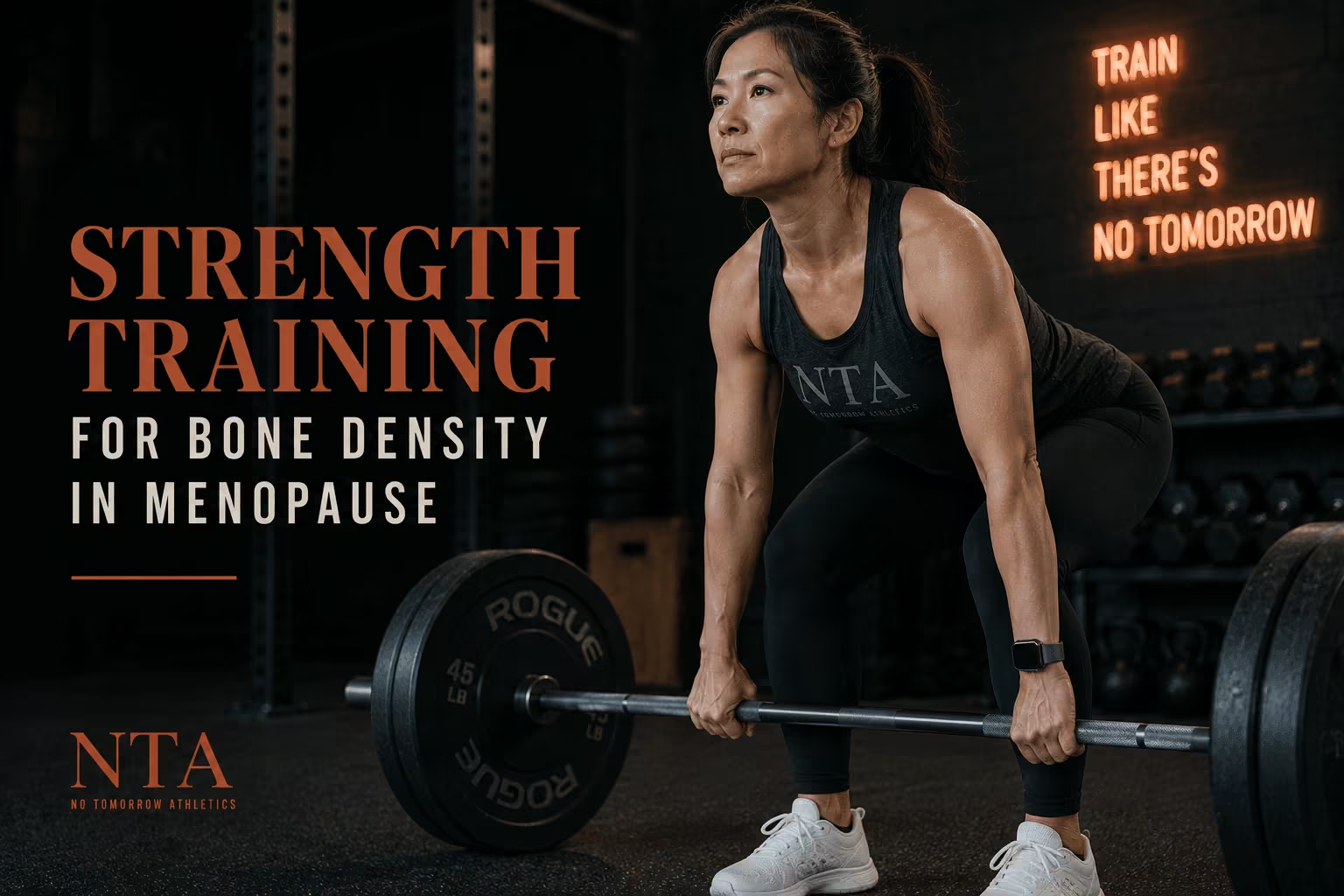
Load and intensity matter. Training in the 70 to 85 percent of one-rep max range, which corresponds to roughly 6 to 12 repetitions with a weight that is genuinely challenging in the final reps, produces the mechanical stimulus that drives both muscle hypertrophy and bone density adaptation 7. Sub-maximal loading that never approaches genuine effort does not produce the same bone remodeling response. The bones need to be loaded close to their capacity to signal remodeling, which is why walking, while valuable for other reasons, is not a substitute for resistance training when bone density is the goal.
Perimenopause also requires more attention to recovery than most women's 30s demanded. Hormonal fluctuation disrupts sleep quality and increases systemic inflammation during certain phases of the cycle. Programming that allows 48 to 72 hours between sessions targeting the same muscle groups, and that includes deliberate mobility work alongside strength sessions, reduces injury risk and supports consistent training across months and years. Consistency over time is the variable that determines outcome. One great training block followed by a prolonged gap produces worse long-term results than 18 months of moderate, regular training.
Why Starting Now Matters More Than Starting Later
There is a persistent idea in women's health that serious resistance training is something to begin once menopause has been confirmed. The logic is understandable: the research on resistance training and menopause is substantial, and that is when most physicians have the conversation. But that framing treats perimenopause as a waiting room rather than a window.
The physiological changes that drive muscle loss, visceral fat accumulation, and bone density decline begin during perimenopause. The adaptations that resistance training produces, increased lean mass, improved insulin sensitivity, stronger and denser bone, take months to years to develop meaningfully. A woman who begins serious strength training at 42 has years of adaptation built before menopause compounds those losses. A woman who starts at 55, after a decade of gradual decline, is rebuilding from a lower baseline and with a hormonal environment that makes adaptation harder.
The research on bone density makes this concrete. Peak bone mass is influenced by loading throughout adulthood, but the perimenopausal years represent an accelerated loss period that well-timed resistance training can measurably offset 8. The same principle applies to muscle mass. Starting earlier does not mean the work is easier. It means the results compound from a better starting point.
At No Tomorrow Athletics, the Strength pillar exists for exactly this reason. Not aesthetics first, though there is nothing wrong with caring about how you look and feel. Strength because a body that is stronger, denser, and more metabolically capable handles every other demand better, including the demands of a hormonal transition that starts earlier than most women are told to expect.
The training window that matters most for perimenopause is not the one that opens after symptoms become severe. It is the one that is already open. The question is whether you use it.
For more on what happens to muscle and weight after the transition completes, the research on muscle loss in menopause and menopause weight gain covers the downstream picture. If bone density is a primary concern, strength training for bone density in menopause goes deeper on the specific loading parameters and the evidence behind them.
Sources
- Cunningham AC, Hewings-Martin Y, Wickham AP, Prentice C, Payne JL, Zhaunova L. Perimenopause Symptoms, Severity, and Healthcare Seeking in Women in the US. npj Women's Health, 2025.
- Maltais ML, Desroches J, Dionne IJ. Changes in Muscle Mass and Strength After Menopause. Journal of Musculoskeletal and Neuronal Interactions, 2009.
- Greendale GA, Sternfeld B, Huang M, Han W, Karvonen-Gutierrez C, Ruppert K, Cauley JA, Finkelstein JS, Jiang SF, Karlamangla AS. Changes in Body Composition and Weight During the Menopause Transition. JCI Insight, 2019.
- Carr MC. The Emergence of the Metabolic Syndrome With Menopause. Journal of Clinical Endocrinology and Metabolism, 2003.
- Lephart ED. Skin Aging and Oxidative Stress: Equol's Anti-Aging Effects via Biochemical and Molecular Mechanisms. Ageing Research Reviews, 2016.
- Berin E, Hammar M, Lindblom H, Lindh-Åstrand L, Rubér M, Spetz Holm AC. Resistance Training for Hot Flushes in Postmenopausal Women: A Randomised Controlled Trial. Maturitas, 2019.
- Shojaa M, von Stengel S, Kohl M, Schoene D, Kemmler W. Effects of Dynamic Resistance Exercise on Bone Mineral Density in Postmenopausal Women: A Systematic Review and Meta-Analysis With Special Emphasis on Exercise Parameters. Osteoporosis International, 2020.
- Watson SL, Weeks BK, Weis LJ, Harding AT, Horan SA, Beck BR. High-Intensity Resistance and Impact Training Improves Bone Mineral Density and Physical Function in Postmenopausal Women With Osteopenia and Osteoporosis: The LIFTMOR Randomized Controlled Trial. Journal of Bone and Mineral Research, 2018.
Frequently Asked Questions
About the author