Most women enter perimenopause without anyone telling them what is actually happening to their body. That changes here.
In the two to three years surrounding the final menstrual period, women lose bone density at a rate of 1 to 3 percent per year, accelerating to as much as 5 percent annually in early postmenopause 1. Simultaneously, the rate of muscle loss accelerates beyond the standard aging trajectory: women can lose up to 3 percent of skeletal muscle mass per year during the menopausal transition when they are not training specifically to prevent it 2. These are not abstract statistics. They are the physiological baseline for every woman who goes through this transition without a structured resistance training program.
Strength training for menopause is not a trend. It is the most well-supported non-pharmacological intervention for two of the most significant health risks the menopausal transition introduces. This post makes the evidence-based case for why, and what the training actually needs to look like.
What Estrogen Was Actually Doing
Estrogen is not primarily a reproductive hormone. That framing undersells it. Estrogen receptors are distributed throughout skeletal muscle, bone, connective tissue, and the central nervous system. When estrogen levels are stable, it acts as a continuous anabolic signal: promoting muscle protein synthesis, activating satellite cells that repair damaged muscle fibers, supporting the osteoblast activity that maintains bone density, and reinforcing the structural integrity of tendons and ligaments 3.
When estrogen declines through perimenopause and into postmenopause, that baseline signal drops away. The body does not receive the same prompt to maintain muscle and bone that it did throughout a woman's reproductive years. Anabolic resistance increases, meaning the stimulus required to drive muscle protein synthesis rises at exactly the moment the body's default maintenance signaling is falling 4. Bone remodeling tips toward net resorption. Connective tissue becomes less elastic and more prone to injury.
This is not inevitable deterioration. It is a predictable hormonal shift with a well-documented mechanical countermeasure. Resistance training creates mechanical load. Mechanical load is an independent signal to both bone and muscle, working through pathways that do not require estrogen 5. The training does not replace estrogen. It bypasses the dependence on it.
The Case for Bone: Mechanical Load as Medicine
Bone is living tissue that responds to the forces placed on it. Osteoblasts build bone in response to mechanical stress; osteoclasts break it down when the stress is absent. During the years of estrogen sufficiency, estrogen supports osteoblast activity and suppresses osteoclast activity, keeping that balance in favor of density. As estrogen falls, the balance shifts toward resorption.
Resistance training restores mechanical stimulus to bone through two mechanisms. Ground reaction forces and direct axial loading during compound movements like squats, deadlifts, and carries create compression forces that signal osteoblast activity. The muscular contractions involved in heavy lifting also apply tensile force to the bone at attachment points, which drives further adaptive remodeling 5. Neither mechanism requires estrogen.
A 2022 meta-analysis of postmenopausal women found that progressive resistance training produced significant improvements in lumbar spine and femoral neck bone mineral density, with effect sizes increasing with load and progressive overload 6. The key word is progressive. Walking does not produce sufficient mechanical stimulus. Yoga does not either. The bone responds to load it has not adapted to yet. The prescription has to include progressive overload, not just movement.
For women already managing low bone density or osteopenia, the threshold for what is appropriate should be established with a physician. But the evidence for resistance training as a primary intervention is strong enough that the default assumption should be doing the work, not avoiding it.
The Case for Muscle: Why "Toning" Is the Wrong Prescription
The persistent recommendation to do high-repetition, low-load training to "tone" is not based on evidence for the outcome that matters most in this population: preserving skeletal muscle mass and function. Toning is an aesthetic framing for a physiological problem, and the physiology requires a different stimulus.
Muscle hypertrophy and maintenance are driven by mechanical tension and metabolic stress applied to the muscle. Research consistently shows that loads at or above 60 to 70 percent of one-rep maximum are required to drive meaningful hypertrophic adaptation, particularly in populations with elevated anabolic resistance 4. Postmenopausal women are a population with elevated anabolic resistance. The appropriate response is to increase the stimulus, not reduce it.
A 2021 review in the Journal of Strength and Conditioning Research found that resistance training at moderate to high loads produced significantly greater improvements in lean mass and functional strength in postmenopausal women than low-load protocols, with compound multi-joint movements outperforming machine-based isolation work 7. Compound movements recruit more motor units, impose greater systemic metabolic demand, and transfer more directly to the functional strength that determines independence and injury risk as women age.
The minimum effective dose, based on current evidence, is 2 to 3 days per week of structured resistance training using compound movements: squat patterns, hinge patterns, pressing, pulling, and loaded carries 8. That is a floor, not a ceiling. Most women in this population will benefit from 3 to 4 days per week once they have developed work capacity.
Protein: The Other Half of the Equation
Resistance training creates the stimulus for muscle protein synthesis. Dietary protein provides the substrate. Without adequate protein, the training signal fires without the material to act on it.
Current evidence from sports nutrition research supports protein intake at 1.6 to 2.2 grams per kilogram of bodyweight per day for individuals engaged in resistance training 9. For postmenopausal women, where anabolic resistance is elevated and the hormonal environment is less favorable to muscle preservation, targeting the higher end of that range is the more conservative and better-supported choice.
Distribution matters as much as total intake. Research from the ISSN's position stand on protein and exercise supports spreading intake across 3 to 4 meals, with 30 to 40 grams of high-quality protein per meal, to maximize muscle protein synthesis across the day 9. The specific habit of prioritizing protein at breakfast tends to matter most practically, because it is the meal women most frequently undereat.
Leucine, the amino acid most responsible for triggering the muscle protein synthesis pathway, is found at highest concentrations in animal proteins: meat, fish, eggs, and dairy. Plant proteins can meet the total target, but typically require higher total volume to deliver equivalent leucine per meal 9.
Metabolic Health and the Broader Picture
Muscle mass is metabolically active tissue. More of it means higher resting metabolic rate, better glucose disposal, and improved insulin sensitivity. The menopausal transition is associated with a shift in body composition toward central adiposity and increased insulin resistance, even in the absence of significant weight change 10. Resistance training directly addresses the underlying mechanism: preserving and building the lean mass that keeps metabolic rate higher and glucose metabolism more efficient.
A 2023 study in Menopause found that postmenopausal women who engaged in progressive resistance training for 16 weeks showed significant improvements in fasting glucose, insulin sensitivity, and visceral fat compared to a control group, independent of changes in total body weight 10. The training improved metabolic markers without requiring weight loss as an intermediate step. That finding matters because weight loss during the menopausal transition is genuinely difficult, and waiting for the scale to move before expecting metabolic benefit leaves the underlying problem unaddressed.
Vascular health also responds to resistance training. Regular strength training reduces resting blood pressure, improves arterial compliance, and lowers LDL cholesterol in postmenopausal women, all of which become relevant as the cardioprotective effect of estrogen declines 8. The cardiovascular benefit of resistance training in this population is often underemphasized relative to aerobic work, but the evidence for it is substantial.
What This Looks Like at No Tomorrow Athletics
The No Tomorrow Method is built on three pillars: Strength, Conditioning, and Mobility. For women navigating the menopausal transition, the Strength pillar is the anchor. Not because conditioning and mobility don't matter, but because the physiological risks of this transition, bone density loss and muscle loss, require mechanical load as their primary countermeasure. The three-pillar structure means conditioning and mobility work supports the strength work rather than competing with it or substituting for it.
The Strength work at NTA is built around compound movements: squat, hinge, press, pull, carry. Progressive overload is not optional and it is not accidental. Every training block is designed to increase the demand over time, because the adaptation requires it. The loads are challenging by design.
The programming at NTA accounts for the full picture: how heavy compound training interacts with conditioning volume, how mobility work reduces injury risk under load, and how recovery is structured to make the training sustainable across years, not weeks. That last point matters here specifically, because the benefits of resistance training for bone density and muscle mass are not acute. They compound over time. The program has to be one you can show up to consistently, which means it cannot be designed to be survived. It has to be designed to be repeated.
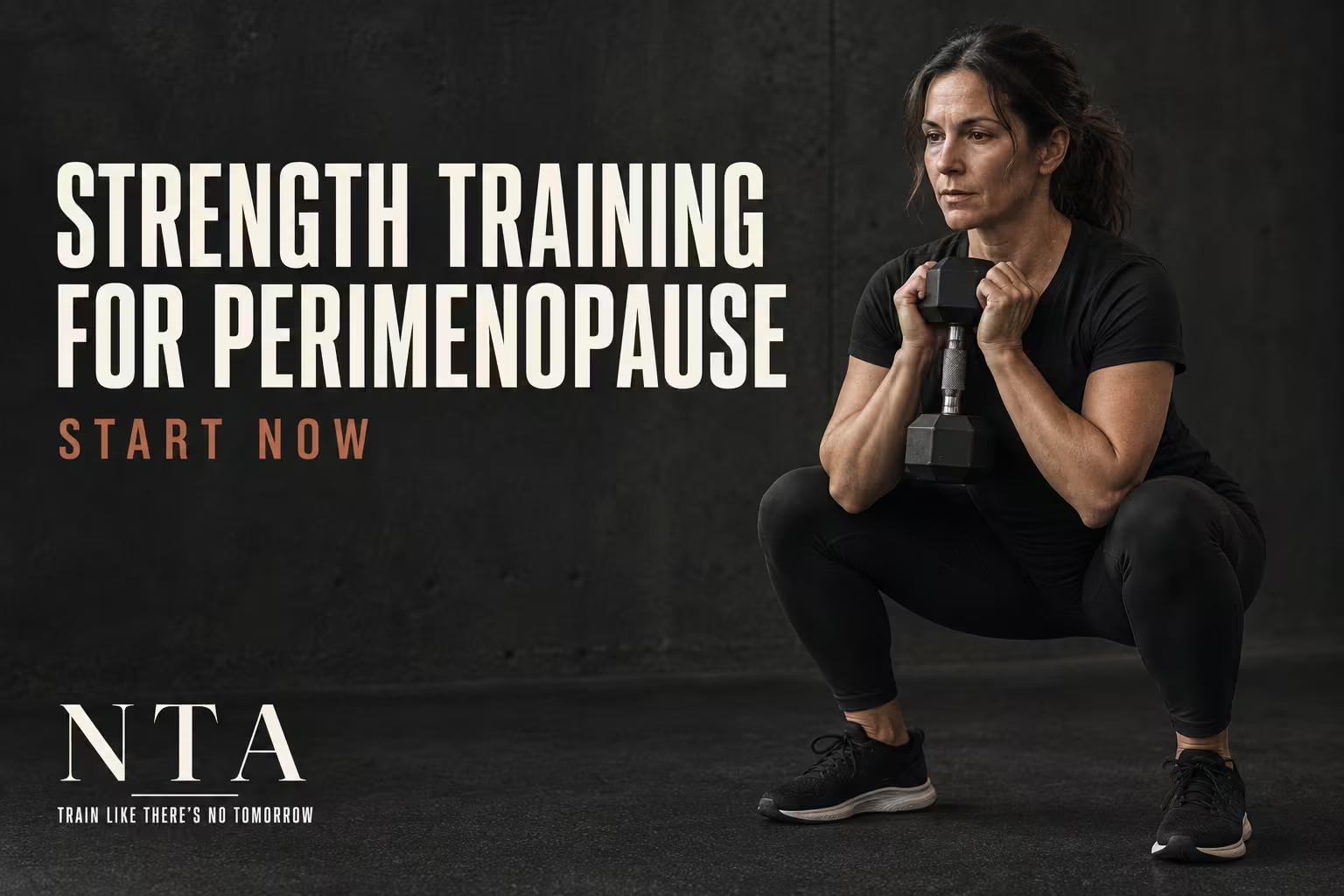
If you are in perimenopause or postmenopause and not currently doing structured, progressive resistance training, you are losing muscle and bone on a timeline the research describes very clearly. The good news is that the intervention is also clear. Start now. The biology responds at any age, and the window to protect what you have is always the present.
No Tomorrow Athletics is accepting founding members in Essex County, NJ. If this is the framework you have been looking for, the door is open.
Sources
- Eastell R, O'Neill TW, Hofbauer LC, Langdahl B, Reid IR, Gold DT, Cummings SR. Postmenopausal Osteoporosis. Nature Reviews Disease Primers, 2016.
- Wright VJ, Schwartzman JD, Itinoche R, Wittstein J. The Musculoskeletal Syndrome of Menopause. Climacteric, 2024.
- Barros RPA, Gustafsson JÅ. Estrogen Receptors and the Metabolic Network. Cell Metabolism, 2011.
- Pérez-Castillo IM, Rueda R, Pereira SL, Bouzamondo H, López-Chicharro J, Segura-Ortiz F, Atherton PJ. Age-Related Anabolic Resistance: Nutritional and Exercise Strategies, and Potential Relevance to Life-Long Exercisers. Nutrients, 2025.
- Kumar S, Smith C, Clifton-Bligh RJ, Beck BR, Girgis CM. Exercise for Postmenopausal Bone Health — Can We Raise the Bar? Current Osteoporosis Reports, 2025.
- O'Bryan SJ, Giuliano C, Woessner MN, Vogrin S, Smith C, Duque G, Levinger I. Progressive Resistance Training for Concomitant Increases in Muscle Strength and Bone Mineral Density in Older Adults: A Systematic Review and Meta-Analysis. Sports Medicine, 2022.
- Fragala MS, Cadore EL, Dorgo S, Izquierdo M, Kraemer WJ, Peterson MD, Ryan ED. Resistance Training for Older Adults: Position Statement From the National Strength and Conditioning Association. Journal of Strength and Conditioning Research, 2019.
- Chodzko-Zajko WJ, Proctor DN, Fiatarone Singh MA, Minson CT, Nigg CR, Salem GJ, Skinner JS. Exercise and Physical Activity for Older Adults. Medicine and Science in Sports and Exercise, 2009.
- Stokes T, Hector AJ, Morton RW, McGlory C, Phillips SM. Recent Perspectives Regarding the Role of Dietary Protein for the Promotion of Muscle Hypertrophy with Resistance Exercise Training. Nutrients, 2018.
- Nunes PRP, Castro-e-Souza P, de Oliveira AA, Camilo BF, Cristina-Souza G, Vieira-Souza LM, Carneiro MAS. Effect of Resistance Training Volume on Body Adiposity, Metabolic Risk, and Inflammation in Postmenopausal and Older Females: Systematic Review and Meta-Analysis of Randomized Controlled Trials. Journal of Sport and Health Science, 2024.
Frequently Asked Questions
About the author