Women lose up to 20% of their bone density in the five to seven years following menopause 1. Most of them are not in a gym. They are walking, taking yoga classes, and doing exactly what they were told was good for their health — and it is not enough.
Strength training for bone density is not a niche concern for women with a DEXA scan on their refrigerator. It is one of the most well-supported applications of resistance training in the research, and one of the most under-practiced. If you are a woman in your 40s, 50s, or 60s and you are not lifting progressively heavy loads, you are leaving your skeletal health undefended.
Why Menopause Accelerates Bone Loss
Bone is not static tissue. It is constantly being broken down by cells called osteoclasts and rebuilt by cells called osteoblasts. Estrogen plays a direct role in suppressing osteoclast activity, which means it acts as a brake on bone resorption. When estrogen drops in menopause, that brake releases.
The result is a remodeling imbalance that tips sharply toward loss. Trabecular bone — the spongy interior lattice that gives bones their structural integrity — is hit hardest and earliest 2. Lumbar vertebrae and the hip are particularly vulnerable. That is why osteoporotic fractures cluster there, and why a hip fracture in a woman over 65 carries a one-year mortality rate of roughly 20% 3.
This is the physiological context you are training against. It is not subtle and it does not wait.
What Wolff's Law Actually Means for Your Training
Wolff's Law, first articulated by German anatomist Julius Wolff in 1892, holds that bone adapts its structure in response to the mechanical demands placed on it. Apply load, bone remodels and strengthens. Remove load, bone resorbs and weakens. The law has held up across more than a century of research and remains the foundational principle behind resistance training as a bone intervention.
The critical word in Wolff's Law is mechanical demand. Bone does not respond to effort. It does not respond to discomfort or elevated heart rate or the feeling that you worked hard. It responds to load. Specifically, to strain — the deformation of bone tissue under force — which triggers osteoblast activity and initiates the remodeling cycle that produces new bone 4.
For that signal to be meaningful, the load has to be meaningful. A mechanical strain threshold exists below which bone simply does not respond. Research consistently places that threshold in the range of 70–85% of one-rep maximum for resistance training 5. Below that threshold, you are maintaining general fitness. You are not stimulating bone.
Why Walking Is Not Enough
Walking is good for you. This is not an argument against walking. But when bone density is the goal, walking fails on the physics.
Walking generates ground reaction forces of roughly 1.0 to 1.2 times body weight. Those forces are real, but they are well below the strain threshold required to stimulate osteoblast activity in postmenopausal women, whose bone tissue has already lost significant density and whose reduced estrogen means the remodeling system is already compromised 6. The stimulus is familiar. Familiar does not build bone.
Swimming and cycling generate even less skeletal load than walking — they are near-zero weight-bearing activities, which is why they offer cardiovascular benefit with almost no bone benefit. Studies comparing sedentary women to swimmers have found no significant difference in hip bone mineral density 7.
Yoga and Pilates offer mobility benefits and some muscular endurance, but without progressive external load, they do not reach the strain threshold either.
None of this makes those activities worthless. It makes them incomplete if skeletal health is the objective.
The Movements That Actually Load Bone
The exercises with the strongest evidence for bone mineral density improvement share a common profile: they are compound, they are loaded externally, and they create high mechanical force through the skeletal sites most vulnerable to osteoporotic fracture.
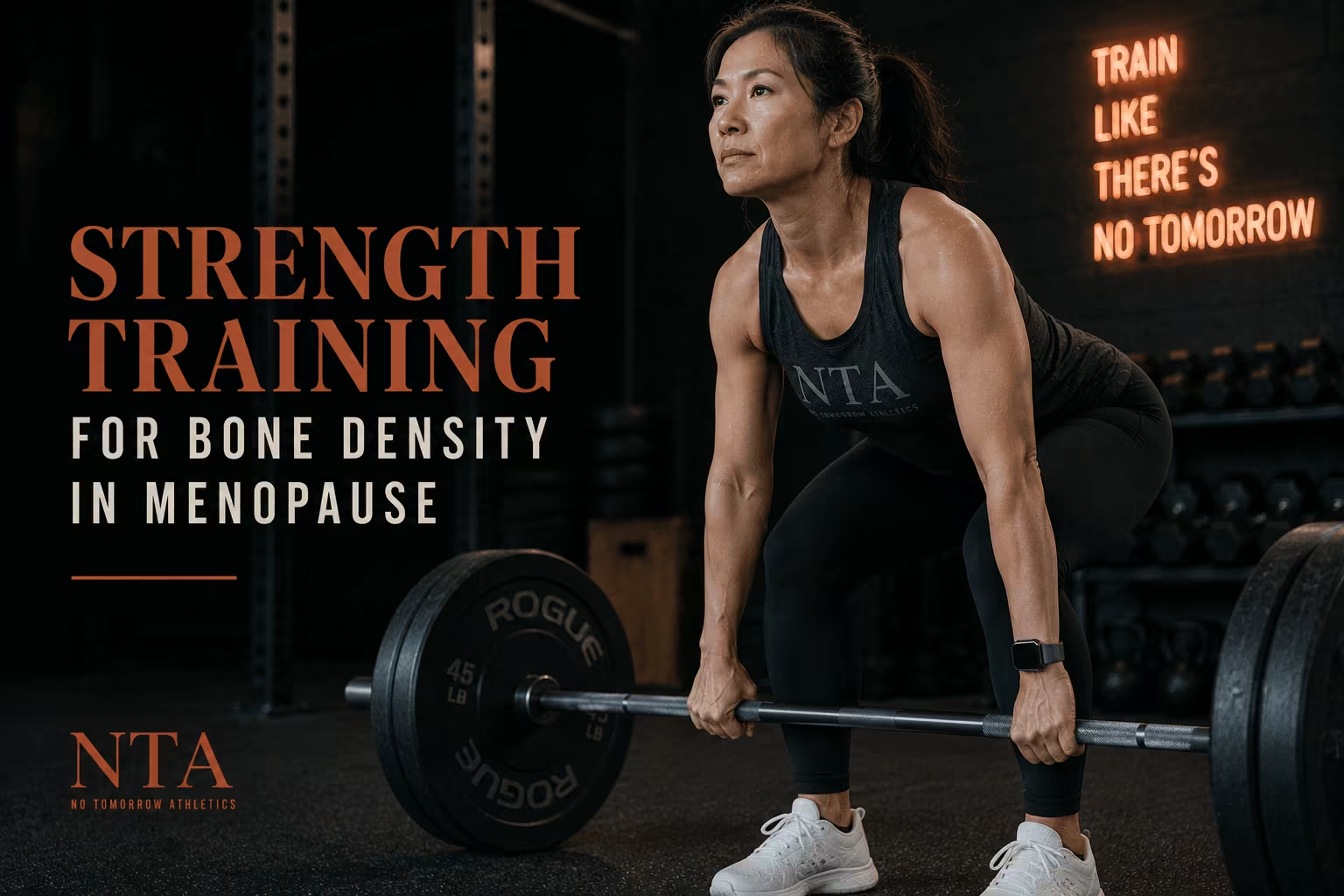
Squats and deadlifts load the lumbar spine and hips under axial compression. These are the two sites where osteoporotic fractures cause the most serious consequences. A barbell back squat at 75% of one-rep max places compressive forces through the spine that walking cannot approach 4.
Hip hinge variations — Romanian deadlifts, trap bar deadlifts, single-leg deadlifts — reinforce the posterior chain while loading the femoral neck, the most common fracture site in hip osteoporosis.
Loaded carries and overhead pressing create axial and compressive loading through the spine and shoulder girdle, regions that benefit from the stimulus but rarely receive it from conventional activity.
Machines isolate muscles without loading the skeleton in the same integrated, multi-joint pattern. A leg press does not replicate the spinal loading of a squat. A cable pull does not replicate the skeletal demand of a deadlift. The research on bone response to resistance training favors free, compound, externally loaded movement 5.
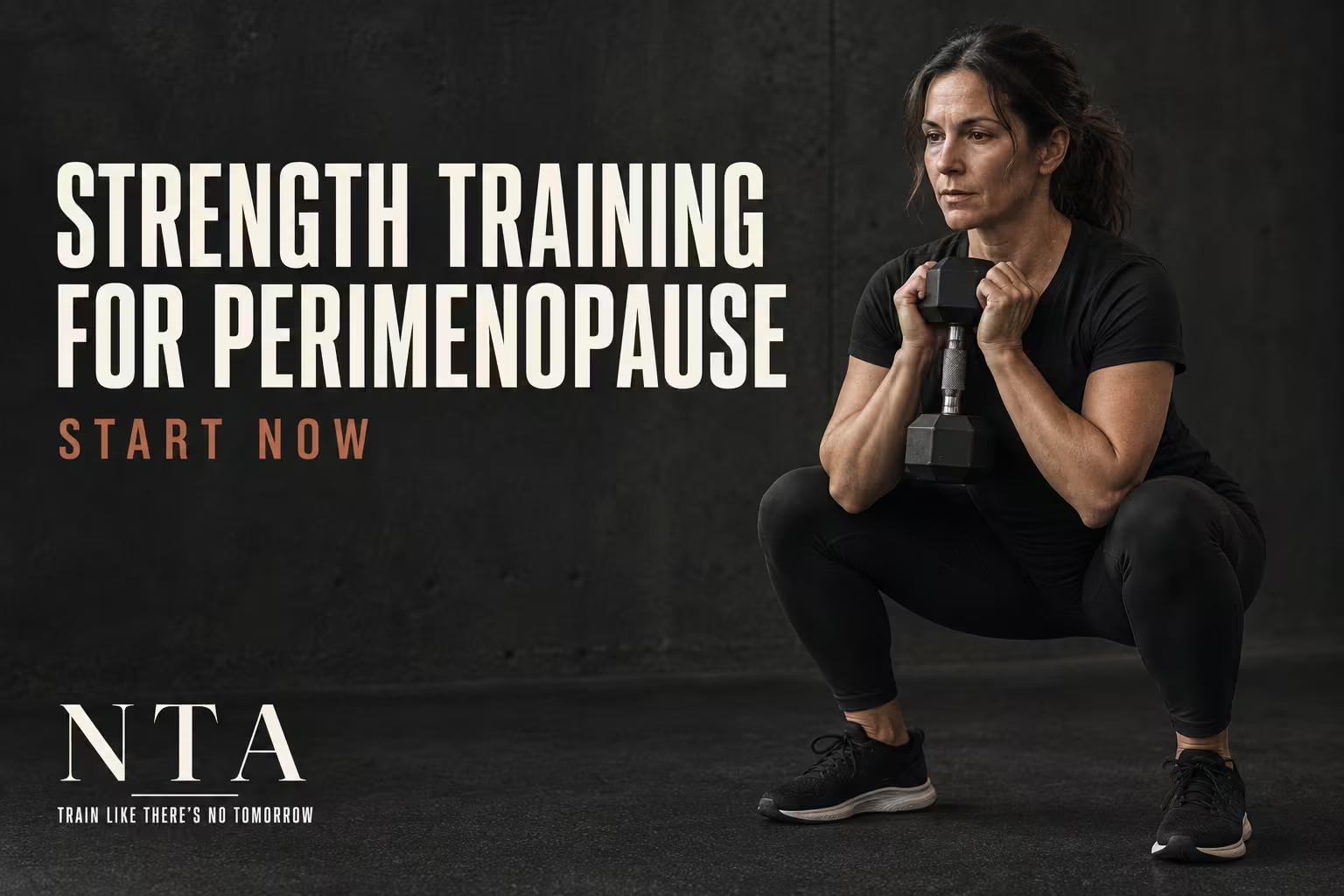
On loading parameters: the evidence supports sets of 8 to 10 repetitions at 70–85% of one-rep maximum, performed two to three times per week, with progressive overload over time 58. The word progressive matters. Bone adapts to a stimulus and then normalizes to it. If the load never increases, the stimulus plateaus and adaptation stops. This is why a program — not just an activity — is what bone density requires.
Heavy Is the Point, Not the Risk
The most common reason women with low bone density avoid heavy lifting is fear of injury. It is an understandable fear and a deeply counterproductive one.
Fragility fractures, by definition, happen under minimal load. A vertebral compression fracture from bending to pick up a bag of groceries. A hip fracture from a low-level fall. These are the outcomes that bone loss produces when nothing is done. The fractures are not caused by lifting — they are caused by the absence of it.
A 2022 meta-analysis in the Journal of Bone and Mineral Research found that high-intensity resistance training (defined as loads at or above 70% of one-rep maximum) produced significantly greater improvements in femoral neck and lumbar spine bone mineral density compared to low-intensity training, with no increase in adverse events in postmenopausal women 8. The training is not the risk. The training is the protection.
Coaching matters here. The distinction between a back squat performed with proper mechanics under progressive load and a heavy squat performed with poor mechanics is significant. That is not an argument against squatting. It is an argument for learning to squat correctly, which is what every athlete at No Tomorrow Athletics does before loading is added.
The No Tomorrow Method is built on three pillars: Strength, Conditioning, and Mobility. The Strength pillar exists precisely to deliver the kind of progressive mechanical load that keeps bone healthy, muscle mass intact, and the body capable of demanding work for decades. We test athletes before we load them. We progress load over time. We treat the squat pattern as something to be earned and maintained, not avoided.
Osteoporosis is not inevitable. It is, in large part, a training problem — and training can address it. The key takeaway is this: progressive resistance training at meaningful loads, focused on compound movement, performed consistently over time, is the most effective non-pharmacological intervention for bone density in menopausal and postmenopausal women. The research is not ambiguous on this point.
For a deeper look at how strength, conditioning, and mobility work together as a complete performance methodology, see our guide to the No Tomorrow Method.
Your bones are making a decision right now about whether to hold or to thin. The question is what signal you are giving them.
Sources
- Karlamangla AS, Burnett-Bowie SM, Crandall CJ. Bone Health During the Menopause Transition and Beyond. Obstetrics and Gynecology Clinics of North America, 2018.
- Cauley JA. Estrogen and Bone Health in Men and Women. Steroids, 2015.
- Haentjens P, Magaziner J, Colón-Emeric CS, Vanderschueren D, Milisen K, Velkeniers B, Boonen S. Meta-Analysis: Excess Mortality After Hip Fracture Among Older Women and Men. Annals of Internal Medicine, 2010.
- Kohrt WM, Bloomfield SA, Little KD, Nelson ME, Yingling VR. American College of Sports Medicine Position Stand: Physical Activity and Bone Health. Medicine and Science in Sports and Exercise, 2004.
- Watson SL, Weeks BK, Weis LJ, Harding AT, Horan SA, Beck BR. High-Intensity Resistance and Impact Training Improves Bone Mineral Density and Physical Function in Postmenopausal Women With Osteopenia and Osteoporosis: The LIFTMOR Randomized Controlled Trial. Journal of Bone and Mineral Research, 2018.
- Moreira LDF, Oliveira MLD, Lirani-Galvão AP, Marin-Mio RV, Santos RND, Lazaretti-Castro M. Physical Exercise and Osteoporosis: Effects of Different Types of Exercises on Bone and Physical Function of Postmenopausal Women. Arquivos Brasileiros de Endocrinologia e Metabologia, 2014.
- Gomez-Bruton A, Montero-Marín J, González-Agüero A, Gómez-Cabello A, García-Campayo J, Moreno LA, Casajús JA, Vicente-Rodríguez G. Swimming and Peak Bone Mineral Density: A Systematic Review and Meta-Analysis. Journal of Sports Sciences, 2018.
- O'Bryan SJ, Giuliano C, Woessner MN, Vogrin S, Smith C, Duque G, Levinger I. Progressive Resistance Training for Concomitant Increases in Muscle Strength and Bone Mineral Density in Older Adults: A Systematic Review and Meta-Analysis. Sports Medicine, 2022.
Frequently Asked Questions
About the author