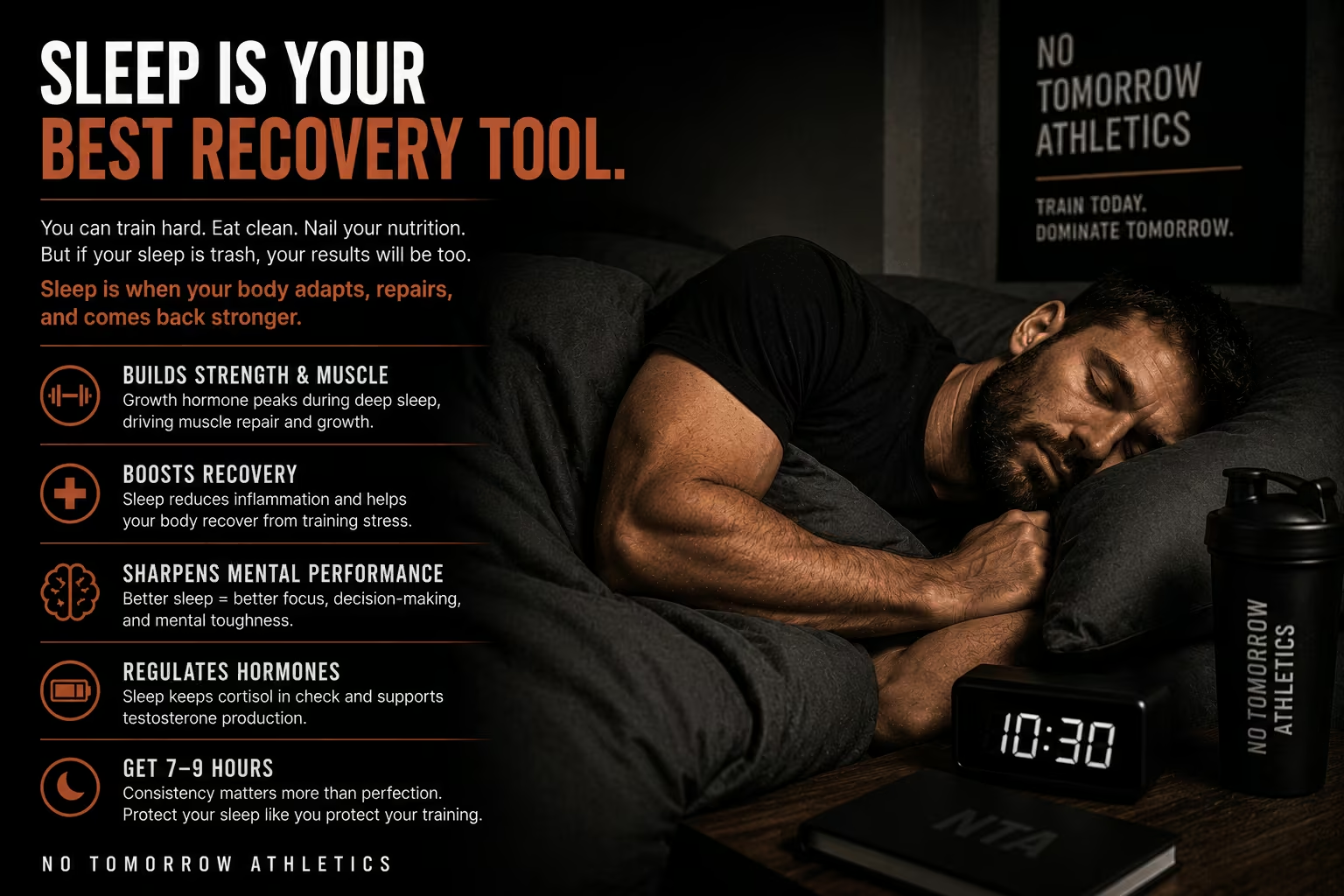
You are not tired because you trained hard. You are tired because you are not sleeping enough.
Sleep for muscle recovery is not a wellness talking point. It is the single most evidence-supported lever an athlete can pull — and most athletes are not pulling it. They are buying peptides, booking cryotherapy, and stacking their post-workout stack. Meanwhile they are sleeping six hours a night and wondering why they are not progressing.
What Actually Happens While You Sleep
Sleep is not passive. It is the most anabolic window in a 24-hour cycle.
During slow-wave sleep (SWS), the anterior pituitary releases the majority of its daily growth hormone output.¹ That GH pulse drives muscle protein synthesis — the process by which damaged muscle fibers are repaired and rebuilt stronger. Interrupt that window, shorten it, or fragment it, and you blunt the signal.
Testosterone follows a similar pattern. Levels rise steadily through the night and peak during the final hours of sleep.¹ Cut sleep short and you cut off the top of that curve. One week of under-sleeping — defined in research as under six hours per night — reduces testosterone levels in healthy men by up to 15%.² Sleep disruption is also one of the earliest and most reliable markers that training load has exceeded recovery capacity.
The Cortisol Problem
Sleep deprivation does not just lower anabolic hormones. It raises cortisol. Elevated cortisol accelerates muscle protein breakdown, impairs glucose metabolism, and suppresses immune function.³ This is the opposite of what an athlete in a training block needs. You are not in a recovery state. You are in a catabolic state wearing recovery clothes.
HRV is the most accessible daily readout of whether your sleep is actually producing recovery — a pattern of suppressed HRV almost always traces back to sleep quality first.
The Numbers That Matter
Research is specific here, so we should be too.
Athletes sleeping fewer than 8 hours per night show a 1.7x greater injury risk than those sleeping 8 or more.⁴ Reaction time after 17 to 19 hours of wakefulness is equivalent to a blood alcohol concentration of 0.05%.⁵ A single night of sleep restriction to 4 hours reduces maximal strength output by approximately 3% — which is meaningful at any competitive level.⁶
The target range for competitive athletes is 8 to 10 hours. For recreational athletes training 4 or more days per week, the floor is 7 hours. These are not suggestions. They are thresholds with documented consequences on the other side.
Why Ice Baths and Saunas Don't Compete
Cold water immersion has real applications. So does sauna. This is not an argument against them.
But cold immersion research shows modest reductions in delayed onset muscle soreness with inconsistent effects on strength recovery — and some evidence that it may actually blunt hypertrophic adaptation when used after resistance training.⁷ Sauna improves cardiovascular markers and heat shock protein expression. Neither does what sleep does.
Sleep is the only recovery tool that repairs muscle, resets the endocrine system, consolidates motor patterns, and prepares the nervous system for the next session — simultaneously, every night, for free.
No ice bath does all of that. No supplement stack comes close. At No Tomorrow Athletics, the athletes who make the most consistent progress are not the ones with the most elaborate recovery protocols. They are the ones who protect their sleep.
What About Naps?
A 20-minute nap improves alertness and reaction time. A 90-minute nap allows one full sleep cycle and can partially offset a poor night.⁸
Naps are useful. They are not a substitute. You cannot nap your way out of chronic sleep restriction. The hormonal and regenerative work of a full night's sleep requires the architecture of a full night's sleep — specifically the repeated cycling through deep slow-wave and REM stages.
Cognitive Performance Is Also on the Table
Muscle repair is not the only reason sleep matters for athletes.
Motor learning — the process by which the nervous system encodes and automates new movement patterns — is heavily sleep-dependent. Research shows that procedural motor memory consolidates during REM sleep.⁹ That means the technique work you did in training is not fully locked in until you sleep on it. Literally.
Decision-making under fatigue degrades faster than perceived effort does. Athletes often feel fine while performing measurably worse. In sport — and in high-intensity training where bad decisions cause injuries — that gap is not acceptable.
What to Actually Do
There are no hacks here. The habits are simple. The commitment is the hard part.
- Set a consistent wake time seven days a week. This is the anchor. Your circadian rhythm is a biological clock. Irregular wake times destabilize it faster than anything else.
- Target 8 hours of time in bed, not just sleep time. Sleep efficiency averages around 85–90%, so an 8-hour sleep target requires roughly 8.5 to 9 hours in bed.
- Drop room temperature to 65–68°F. Core body temperature must fall to initiate sleep. A cool room accelerates that process.¹⁰
- Cut caffeine by 1 PM if your bedtime is 10 PM. Caffeine's half-life is 5 to 6 hours. A 3 PM coffee is still half-active at 9 PM.
- Protect the 90 minutes before bed. Bright screens and high-stimulation content elevate alertness and delay melatonin onset. This is not debated.
- Track it honestly. A basic wearable or even a sleep diary will surface patterns. Most athletes are sleeping less than they think.
At No Tomorrow Athletics, the No Tomorrow Method is built on three pillars: strength, conditioning, and mobility. But the fourth wall every athlete hits eventually is recovery. And recovery starts at night, in bed, not at the cryotherapy center.
You can optimize everything else. If you are sleeping six hours a night, you are leaving the most important variable untouched.
Sources
- Leproult R, Van Cauter E. Role of Sleep and Sleep Loss in Hormonal Release and Metabolism. Endocrine Development, 2010.
- Leproult R, Van Cauter E. Effect of 1 Week of Sleep Restriction on Testosterone Levels in Young Healthy Men. JAMA, 2011.
- Dattilo M, Antunes HKM, Medeiros A, Mônico Neto M, Souza HS, Tufik S, de Mello MT. Sleep and Muscle Recovery: Endocrinological and Molecular Basis for a New and Promising Hypothesis. Medical Hypotheses, 2011.
- Milewski MD, Skaggs DL, Bishop GA, Pace JL, Ibrahim DA, Wren TAL, Barzdukas A. Chronic Lack of Sleep Is Associated with Increased Sports Injuries in Adolescent Athletes. Journal of Pediatric Orthopaedics, 2014.
- Williamson AM, Feyer AM. Moderate Sleep Deprivation Produces Impairments in Cognitive and Motor Performance Equivalent to Legally Prescribed Levels of Alcohol Intoxication. Occupational and Environmental Medicine, 2000.
- Knowles OE, Drinkwater EJ, Urwin CS, Lamon S, Aisbett B. Inadequate Sleep and Muscle Strength: Implications for Resistance Training. Journal of Science and Medicine in Sport, 2018.
- Roberts LA, Raastad T, Markworth JF, et al. Cold Water Immersion Blunts and Delays Increases in Myofibrillar Protein Synthesis After Resistance Exercise. Journal of Physiology, 2015.
- Dutheil F, Bessonnat B, Pereira B, Baker JS, Moustafa F, Fantini ML, Mermillod M, Navel V. Napping and Cognitive Performance During Night Shifts: A Systematic Review and Meta-Analysis. Sleep, 2020.
- Stickgold R. Sleep-Dependent Memory Consolidation. Nature, 2005.
- Harding EC, Franks NP, Wisden W. The Temperature Dependence of Sleep. Frontiers in Neuroscience, 2019.
Frequently Asked Questions
About the author
.avif)
.avif)
.avif)