.avif)
Your HRV score dropped. Now you don't know whether to push or pull back — and that uncertainty is costing you more than the number ever could.
How to use HRV for training is one of the most searched questions in performance right now, and one of the most poorly answered. The tools have gotten good. The literacy around them hasn't kept up. Athletes who track HRV daily are often making training decisions based on a single number, stripped of context, interpreted without baseline, and treated like a binary switch — green means go, red means rest. That's not how the signal works. And at No Tomorrow Athletics, we've watched that misreading lead to overtrained athletes who checked every box and undertrained athletes who had every reason to push.
HRV deserves better than that.
What HRV Actually Measures
Heart rate variability is the measurement of time variation between successive heartbeats — specifically, the intervals between R-peaks on an electrocardiogram, called RR intervals. It is not a measure of heart rate. Two athletes can have the same resting heart rate with very different HRV profiles.
What HRV reflects is the balance between your sympathetic and parasympathetic branches of the autonomic nervous system 1. The sympathetic branch drives arousal, stress response, and output. The parasympathetic branch governs recovery, digestion, and restoration. When parasympathetic activity is high, beat-to-beat variation increases. When sympathetic load dominates — from hard training, poor sleep, psychological stress, illness, or alcohol — that variation compresses.
The RMSSD Number You're Looking At
Most consumer HRV tools report a metric called RMSSD: the root mean square of successive differences between RR intervals. It's the most validated time-domain HRV metric for short-term recordings and is strongly correlated with parasympathetic tone 2. When your app gives you a single HRV number each morning, RMSSD is almost certainly what's underneath it.
It's a legitimate metric. But legitimacy doesn't equal completeness.
What HRV Doesn't Measure
HRV does not measure fatigue directly. It does not measure muscle damage, glycogen depletion, neuromuscular readiness, or training load. It does not know that you slept poorly because of a work deadline rather than physiological stress. It does not know you had two drinks last night. It cannot tell whether your suppressed reading reflects cumulative overreaching or a single bad night.
A low HRV reading is a signal that something is placing load on your system. It cannot tell you what that something is.
That distinction matters enormously. Research published in the International Journal of Sports Physiology and Performance found that while HRV-guided training outperformed fixed-intensity training in several aerobic adaptations, the advantage came from using HRV trends over time — not single-session scores 3. One number, one morning, tells you almost nothing in isolation.
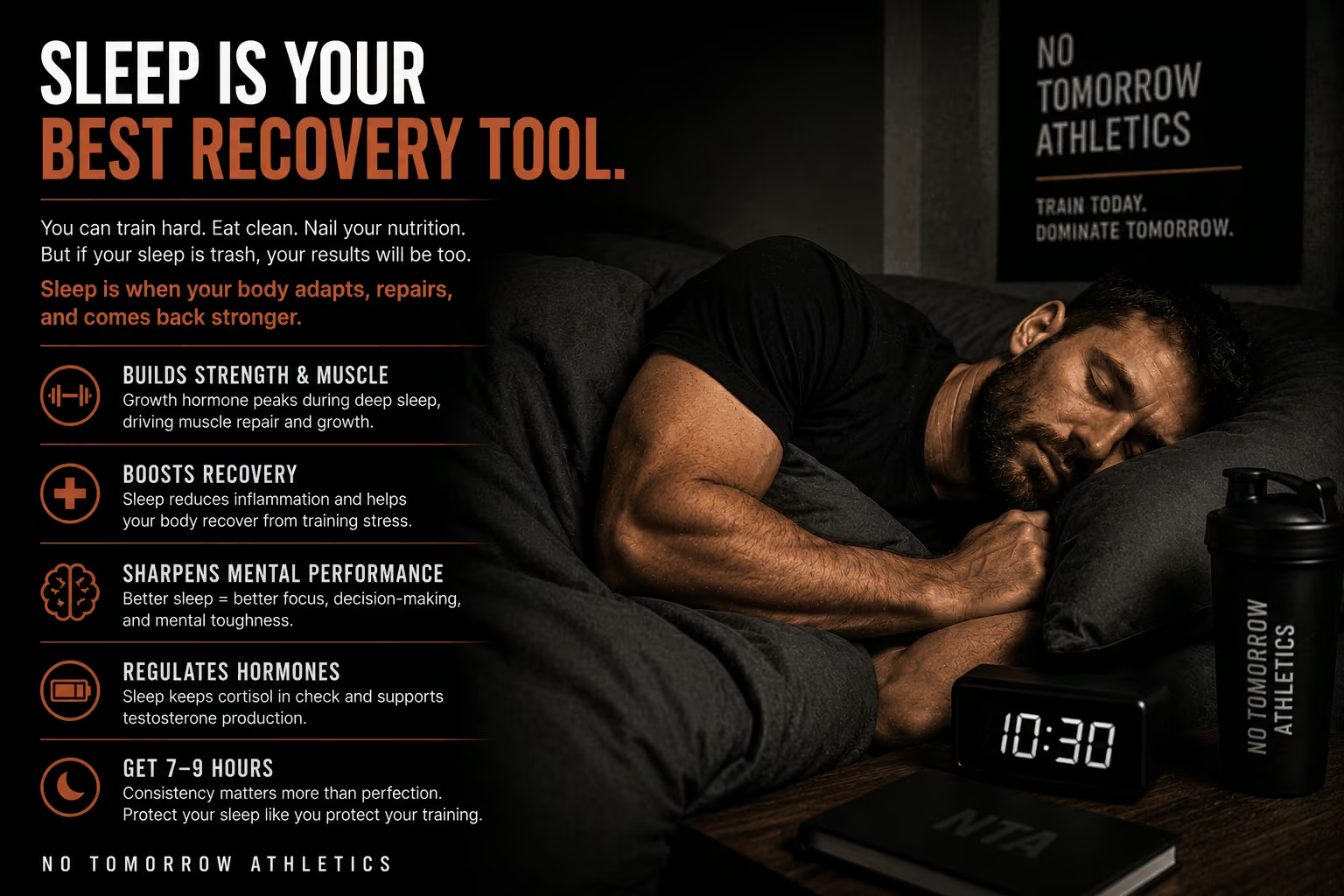
The single variable with the highest day-to-day correlation to HRV is sleep — quality, duration, and fragmentation all move the number more reliably than training load.
The Acute vs. Chronic Confusion
Acute HRV suppression — a single low reading — is common after a hard session, a long travel day, or a stressful week. Chronic suppression — a sustained downward trend over 7 to 14 days — is a different signal entirely and is more closely associated with non-functional overreaching 4. Most athletes treat both the same way. They shouldn't.
If your 7-day HRV average is trending down and your perceived exertion on familiar efforts is climbing, that's a conversation. If your HRV dipped after a Saturday long run and rebounded by Monday, that's physiology working correctly.
How to Use HRV for Training — the Right Way
The No Tomorrow Method treats HRV as one input in a recovery monitoring stack, not the top of the hierarchy. Here's how we frame it with athletes. Consistent Zone 2 training reliably improves baseline HRV over time — it's one of the clearest training signals you can give your autonomic nervous system.
Establish a Personal Baseline First
Industry-wide HRV norms are nearly useless for individual training decisions. A score of 55 might be suppressed for one athlete and elevated for another. You need your own rolling baseline — typically a 7-day or 14-day average — before any single reading carries interpretive weight 5. Most apps build this automatically. The problem is athletes start making decisions before the baseline is meaningful, usually in the first two weeks of use.
Give it 30 days of consistent morning measurements before you trust the trend.
Layer Subjective Data Alongside It
HRV without subjective readiness data is half a picture. At No Tomorrow Athletics, we ask athletes to log three things each morning alongside their HRV: sleep quality (1–5), perceived energy (1–5), and any notable stressors. When HRV and subjective scores align — both low, or both high — the signal is strong. When they diverge, the subjective data often wins 6.
An athlete who reports feeling sharp, motivated, and well-rested despite a slightly suppressed HRV should not automatically downgrade the session. An athlete who feels flat and heavy despite a normal HRV reading deserves the same consideration.
Use It to Modulate, Not Cancel
HRV should change the shape of your training, not whether training happens. If your numbers and subjective data both indicate accumulated load, this isn't necessarily a rest day — it may be a technique day, an aerobic recovery session, or a mobility block. The No Tomorrow Method's three pillars — Strength, Conditioning, Mobility — exist in part so that there is always something productive that matches what your system can handle on a given day.
Rest is a tool. It should be chosen deliberately, not defaulted to because a wearable flashed amber.
HRV gives you the most direct daily window into where you sit in the supercompensation cycle — whether your system is ready to absorb a hard session or needs more time.
Where the Research Actually Stands
A 2022 meta-analysis in Sports Medicine found that HRV-guided training produced superior improvements in maximal oxygen uptake compared to pre-planned training, but the effect size was moderate and the benefit was most pronounced when HRV was used to inform intensity distribution rather than training volume 7. Translation: HRV is better at telling you how hard to go than whether to go.
A 2023 review in the Journal of Strength and Conditioning Research reinforced that context variables — sleep duration, training monotony, and psychological stress — significantly confounded HRV readings and that no single autonomic marker reliably predicted performance readiness in isolation 4.
The science supports HRV as a useful monitoring tool. It does not support HRV as a decision engine.
The Athlete Who Reads This Correctly
The intermediate-to-advanced athlete using HRV well looks like this: they've established a personal baseline over several weeks, they log subjective data alongside objective scores, they look at 7-day trends before reacting to daily fluctuations, and they use suppressed readings as a prompt to ask better questions rather than a reason to skip work. For athletes combining strength and conditioning, HRV is your most reliable tool for determining whether the concurrent load is producing adaptation or accumulating fatigue.
They don't worship the number. They interrogate it.
If you're training at No Tomorrow Athletics and using a wearable, bring your data into the conversation. HRV trends, combined with training logs and how you're moving in the gym, give coaches something real to work with. A number without context is just noise. In context, it becomes useful — sometimes very useful.
Train with information. Decide with judgment. That's the No Tomorrow Method.
Sources
- Shaffer, F., & Ginsberg, J. P. (2017). An Overview of Heart Rate Variability Metrics and Norms. Frontiers in Public Health.
- Plews, D. J., Laursen, P. B., Stanley, J., Kilding, A. E., & Buchheit, M. (2013). Training Adaptation and Heart Rate Variability in Elite Endurance Athletes: Opening the Door to Effective Monitoring. Sports Medicine.
- Kiviniemi, A. M., Hautala, A. J., Kinnunen, H., & Tulppo, M. P. (2007). Endurance training guided individually by daily heart rate variability measurements. European Journal of Applied Physiology.
- Nuuttila, O. P., et al. (2022). Individualized Endurance Training Based on Recovery and Training Status. International Journal of Sports Physiology and Performance. Use this only if you specifically want the 2022 individualized-training source.
- Bellenger, C. R., Fuller, J. T., Thomson, R. L., Davison, K., Robertson, E. Y., & Buckley, J. D. (2016). Monitoring Athletic Training Status Through Autonomic Heart Rate Regulation: A Systematic Review and Meta-Analysis. Sports Medicine.
- Flatt, A. A., & Esco, M. R. (2015). Smartphone-Derived Heart-Rate Variability and Training Load in a Women’s Soccer Team. International Journal of Sports Physiology and Performance.
- Saw, A. E., Main, L. C., & Gastin, P. B. (2016). Monitoring the Athlete Training Response: Subjective Self-Reported Measures Trump Commonly Used Objective Measures: A Systematic Review. British Journal of Sports Medicine.
- Manresa-Rocamora, A., Sarabia, J. M., Javaloyes, A., Flatt, A. A., & Moya, M. (2021). Heart Rate Variability-Guided Training for Enhancing Cardiac-Vagal Modulation, Aerobic Fitness, and Endurance Performance: A Methodological Systematic Review with Meta-Analysis. International Journal of Environmental Research and Public Health.
Frequently Asked Questions
About the author


.avif)
.avif)