
Hyrox does not reward the strongest athlete in the room. It rewards the most complete one.
That distinction is why so many experienced athletes — CrossFitters, runners, gym regulars — show up to their first Hyrox race undertrained for it. They are fit. They are just not fit for this. Hyrox training in New Jersey has grown into a serious competitive pursuit, and if you are preparing for your first or fastest race, the approach you use in the next 12 weeks will determine everything about how that race feels.
This post is the race-specific companion to our Hyrox hub at No Tomorrow Athletics. It is a complete 12-week framework — built around how the race actually works, not around generic conditioning advice.
Why Hyrox Is a Different Problem
Hyrox launched in Hamburg in 2018 with three events. By 2024, it was producing over 100 events annually across more than 50 countries, making it the fastest-growing competitive fitness format in the world 1. That growth is not accidental. The format works because it is universally scalable, brutally honest, and impossible to fake your way through.
The race is this: 8 rounds of a 1km run, each followed by one functional station. The stations — in order — are ski erg, sled push, sled pull, burpee broad jumps, rowing, farmer's carry, sandbag lunges, and wall balls. Total distance covered: approximately 10km of running. Total work: 1,000 meters on the ski erg, 50 meters of sled push at 102kg (men) or 77kg (women), 50 meters of sled pull, 80 burpee broad jumps, 1,000 meters on the row, 200 meters of farmer's carry, 100 meters of sandbag lunges, and 100 wall balls.
No single training quality prepares you for that. Aerobic capacity gets you through the runs. Functional strength gets you through the stations. Muscular endurance keeps both from falling apart in the back half. Athletes who train only one quality consistently underperform on the others, and the race exposes every gap 2.
The NJ and Tri-State Race Landscape
If you are training in New Jersey, you have realistic race targets within driving distance throughout the year. Hyrox events have been held in New York City (Javits Center), Philadelphia, and Newark — with the NYC event typically drawing the largest tri-state field. As of 2024–2025, the Northeast calendar includes events in New York in late fall and early spring, with Philadelphia typically anchoring the mid-Atlantic schedule in winter.
How to Select Your Race
Choose a race that gives you at least 12 weeks of structured preparation from the day you register. Use the NYC or Newark events as your primary targets if you are based in Essex County — travel time is under 30 minutes and the venue logistics are familiar to most NJ athletes. Philadelphia is a strong backup with a slightly smaller competitive field, which can be an advantage for first-timers seeking a less chaotic environment.
Check the official Hyrox event calendar at hyrox.com for current NJ and tri-state listings. Registration sells out faster each year. If a date works for your timeline, do not wait.
The 12-Week No Tomorrow Hyrox Framework
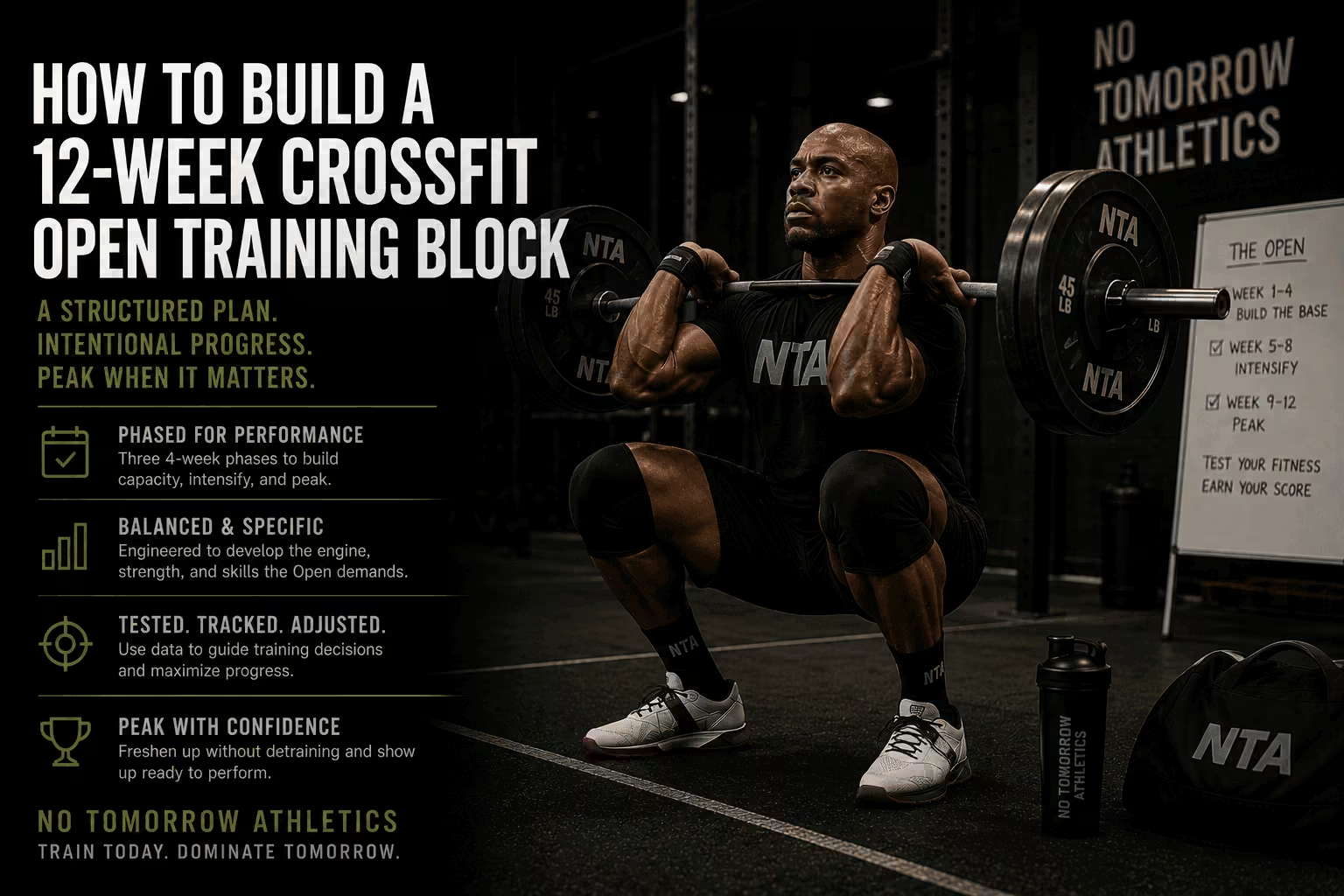
This framework is built on the same structure we use with athletes. It runs in three phases of four weeks each. Each phase has a primary adaptation target. The phases do not overlap — you complete one before building into the next.
Phase 1 — Aerobic Base (Weeks 1–4)
The aerobic base phase is unglamorous and non-negotiable. Most athletes skip it. Most athletes suffer in the back half of their race because of it.
The goal of weeks 1–4 is to build your aerobic engine — specifically your Zone 2 capacity, defined as 60–70% of maximum heart rate, the intensity at which you can hold a conversation but are clearly working 3. Our full breakdown of Zone 2 training and why it matters goes deeper on the physiology. For Hyrox purposes, understand this: the better your Zone 2 base, the more aerobic your race effort becomes, and the less you rely on anaerobic reserves that take far longer to recover between stations.
Training volume in Phase 1 is 3–4 sessions per week. Two of those sessions are pure Zone 2 cardio: 30–45 minutes of running, rowing, or ski erg at 130–150 bpm (adjust for your age and fitness level). One session per week is a longer aerobic effort: 60–75 minutes at the same intensity. The fourth session, if included, is a light full-body strength circuit with no heavy loading — the goal is movement quality, not adaptation stress.
Target 1km run pace in Phase 1: 6:30–7:00/km. If you cannot hold a conversation at this pace, slow down. The adaptation you are building happens below the threshold, not above it.
Phase 2 — Strength Endurance (Weeks 5–8)
Weeks 5–8 shift the emphasis to the stations. By now, your aerobic base is developed enough to tolerate higher-intensity work without collapsing your recovery between sessions. Now you build the station-specific strength endurance that makes the difference between surviving the back half and racing it.
Our strength training methodology covers the principles behind loading for endurance rather than max strength. For Hyrox, you are not trying to build a bigger back squat. You are training your body to produce moderate force repeatedly under accumulated fatigue — which is a different stimulus than traditional strength work 4.
In Phase 2, you train 4 sessions per week. Two sessions are station-specific: you rotate through all eight stations across the week, training each for 3–4 sets at race weight or close to it. The ski erg and sled are introduced here — if you have not trained these movements before, the first two weeks of this phase will feel harder than they should. That is normal. Neurological adaptation to these patterns takes 2–3 weeks of consistent exposure.
Station-Specific Loading Targets
Ski erg: 250-meter intervals at race pace (target: sub-1:10/250m for competitive athletes, sub-1:25 for first-timers). Sled push: 10-meter intervals at 110–120% of race weight to build tolerance. Sled pull: same approach — slightly above race weight, shorter distances. Burpee broad jumps: train in sets of 20 for quality. Row: 250-meter intervals, same pacing logic as ski erg. Farmer's carry: 50-meter intervals at race weight, focus on posture. Sandbag lunges: 20-meter intervals, prioritize hip stability. Wall balls: sets of 25, unbroken, at race height and weight.
The two remaining Phase 2 sessions are aerobic — one Zone 2 run of 45–60 minutes and one tempo run of 20–25 minutes at 80–85% max HR. Do not abandon aerobic work in this phase. It maintains the base you built in weeks 1–4.
Phase 3 — Race Simulation (Weeks 9–12)
This is where the training becomes race training. The goal of Phase 3 is to prepare your body and your brain for what the race actually feels like — the accumulated fatigue, the pacing decisions, the mental negotiation you do in the back half when everything gets hard.
Weeks 9–10 include two full or partial race simulations per week. A partial simulation is 4 rounds of run plus station. A full simulation is all 8. Complete at least one full simulation before race day. Do not skip it. Athletes who race without a full simulation are making decisions on race day that they have never practiced.
The best race simulation is the one that scares you a little — but teaches you something you can actually use.
Week 11 is reduced volume: two light sessions, one short race-pace run, no heavy station work. Week 12 is the taper: three sessions, all light, ending with a 20-minute easy aerobic session two days before the race.
Target race paces for Phase 3 simulations: 5:45–6:15/km for athletes targeting a sub-60-minute finish, 6:15–6:45/km for athletes targeting sub-75 minutes. Hold back 10–15 seconds per km in the first two runs. The race is won or lost in runs 5 through 8, not in the opener.
Recovery Throughout the Block
A 12-week Hyrox build accumulates significant stress. Sleep, nutrition, and soft tissue work are not optional support — they are part of the training. Athletes who underrecovery mid-block do not peak in week 12. They arrive at race day depleted.
Structured recovery protocols matter most in Phase 2 and Phase 3, when training load peaks. Cold immersion and contrast therapy during race week can accelerate soft tissue recovery and nervous system readiness in the final days before competition. We use this with athletes at NTA in the week leading into target events.
Protein intake during a Hyrox block should sit at 1.6–2.2g per kilogram of bodyweight per day, based on current evidence for athletes in combined aerobic and strength training 5. Carbohydrate timing around sessions matters more in Phase 3 than in Phase 1 — prioritize intra-session fueling for any simulation lasting over 45 minutes.
Why the No Tomorrow Method Works for Hyrox
The No Tomorrow Method was built around three pillars: strength, conditioning, and mobility. Hyrox demands all three simultaneously. That is not a coincidence — it is why the methodology transfers so directly to this format.
The coaches at No Tomorrow Athletics have competition backgrounds in CrossFit, Hyrox, and functional fitness. They have stood at the start line. They know what the back half of a Hyrox race feels like, and they have built training systems around that knowledge. If you are preparing for a race in the NJ or tri-state area, that experience matters.
Hyrox training in New Jersey does not have to be guesswork. The framework exists. The coaching exists. The community exists.
Register for a race. Give yourself 12 weeks. Show up ready.
Sources
- Davids CJ. A Performance Analysis of HYROX: A Review of the Physiologic, Mechanical, and Technical Demands. Strength and Conditioning Journal, 2025.
- Meier N, Schlie J, Schmidt A. CrossFit®: 'Unknowable' or Predictable? A Systematic Review on Predictors of CrossFit® Performance. Sports, 2023.
- Seiler S, Tønnessen E. Intervals, Thresholds, and Long Slow Distance: The Role of Intensity and Duration in Endurance Training. Sportscience, 2009.
- Schoenfeld BJ, Grgic J. Does Training to Failure Maximize Muscle Hypertrophy? Strength and Conditioning Journal, 2019.
- Morton RW, Murphy KT, McKellar SR, Schoenfeld BJ, Henselmans M, Helms E, Aragon AA, Devries MC, Banfield L, Krieger JW, Phillips SM. A Systematic Review, Meta-Analysis and Meta-Regression of the Effect of Protein Supplementation on Resistance Training-Induced Gains in Muscle Mass and Strength in Healthy Adults. British Journal of Sports Medicine, 2018.
Frequently Asked Questions
About the author





%20(1).avif)