
You are not losing reps because you are out of shape. You are losing them in the first three minutes.
For Masters athletes competing in the CrossFit Open — specifically those in the 40-plus age brackets — CrossFit Open pacing strategy is not a supplemental concern. It is the primary performance variable. Research supports this directly. Experts found that the ratio of first-half to second-half output was significantly correlated with final Open placement — athletes who went out hard and faded scored measurably lower than those who held even or negative splits 1. That finding does not distinguish by age. The physiology does.
Why Pacing Hits Different After 40
Masters athletes cross the anaerobic threshold faster than their younger counterparts and recover from anaerobic efforts more slowly 2. This is not a motivation problem. It is not a mental toughness problem. It is a physiological reality with direct implications for how you approach a seven-minute Open workout.
When you go out too hard in minute one, you accumulate lactate faster than your system can buffer it. At 25, your body can partially recover from that hole mid-workout. At 42, you cannot. The fade you experience in the back half is not the result of poor fitness. It is the predictable consequence of a pacing error made before the clock hit 90 seconds.
The cost compounds further. An athlete who blows up in week one of the Open is not just losing reps on that workout. They are compromising their recovery capacity for week two and week three. The competition window for the Open spans three weeks. Treating each workout as an isolated event is itself a strategic mistake.
Your Limiting Factor Is Not What You Think
Before you can pace correctly, you have to know what actually limits you in a given workout. There are three primary categories for Masters athletes, and the pacing strategy differs for each.
Aerobic Capacity
If your heart rate spikes and stays high early, your limiter is cardiovascular. The prescription here is a controlled start — deliberately slower than it feels necessary — and maintaining a pace you can sustain aerobically for the first half of the workout before building. Any time you push into the red early, you are borrowing from output you do not have left to spend.
Strength Demand
If the workout includes heavy barbell cycling, loaded carries, or max effort pulls, your limiter is likely local muscular fatigue. The pacing solution here is set management — smaller sets with committed rest, rather than large sets followed by unplanned rest when your grip or legs give out. Breaking sets earlier than you need to is almost always faster than going to failure and staring at the bar 3.
High-Skill Movement
If the workout contains muscle-ups, handstand push-ups, double-unders, or complex gymnastics, your limiter is skill degradation under fatigue. These movements break down when your nervous system is compromised. For Masters athletes, whose neuromuscular recovery between efforts is slower 4, this means the margin for error on high-skill work narrows sharply after the first few minutes. Pace to protect the skill, not to maximize early output.
The Three-Part Masters Pacing Framework
At No Tomorrow Athletics, we build pacing strategy into the competition prep process — not as an afterthought, but as a structured protocol. Here is the framework we use with Masters athletes preparing for the Open.
Step One: Run It at 80% First
Before your scored attempt, do the workout at approximately 80% of max effort. Not to preview the movements. Not to warm up. To identify your actual limiting factor under fatigue. You will not know what breaks down first until something breaks down. The 80% run surfaces that information without the cost of a maximal effort.
What are you watching for? Heart rate, rep quality on high-skill movements, where grip or positioning degrades, and how long into the workout it takes for your breathing to become the primary constraint. That information directly informs your pacing plan for the scored attempt.
Step Two: Know Your Limiter Before the Clock Starts
Based on what your 80% run revealed, assign your workout to one of the three categories above — aerobic, strength, or skill — and build your pacing plan accordingly. This is a decision made before the workout, not a reactive adjustment made when things go wrong. By the time you feel like you need to slow down, you have already slowed down too late.
Write the plan out. Assigned rest intervals, target rep counts per set, the movements where you will deliberately hold back early. Commit to them.
Step Three: Hold Your Rest Intervals When You Feel Good
This is where Masters athletes most often break their own plan. The first three minutes feel manageable. The pace feels sustainable. The temptation is to skip the planned rest, push through, and bank reps while the window is open.
Do not do it.
The first three minutes feeling good is not information about the next four minutes. It is information about the first three minutes. Pre-planned rest intervals exist specifically to prevent the decision-making that happens when you are already in oxygen debt. Commit to them before the clock starts. Honor them when the clock is running.
The first three minutes feeling good is not information about the next four minutes. It is information about the first three minutes.
The Second Attempt Decision for Masters Athletes
Younger athletes can absorb a second maximal attempt with 24 hours of recovery. For Masters athletes, the realistic recovery window is 48 to 72 hours 5. That distinction changes the calculus on whether a second attempt is worth taking.
The criteria should be stricter than you think. A second attempt is justified when you made a clear tactical error — went out too hard, botched a movement standard, experienced equipment failure, or had a genuine off day that was not representative of your fitness. A second attempt is not justified simply because you are confident you can score higher. You probably can. The question is whether the cost to week two and week three of the competition window is worth the marginal improvement on week one.
For most Masters athletes, the answer is no — unless the gap between your first attempt and your realistic ceiling is large enough to meaningfully change your placement, and you have the time to recover fully before the next workout drops.
The Fitness That Pacing Sits On Top Of
Pacing strategy is not a substitute for fitness. It is a way of expressing the fitness you actually have.
The Conditioning pillar of the No Tomorrow Method is built specifically around raising the aerobic ceiling — training Masters athletes to sustain higher output for longer before crossing into anaerobic work. That threshold is not fixed. It is trainable. The goal of twelve weeks of structured Open prep is to move that line, so that the pace you can hold aerobically is the pace that scores well.
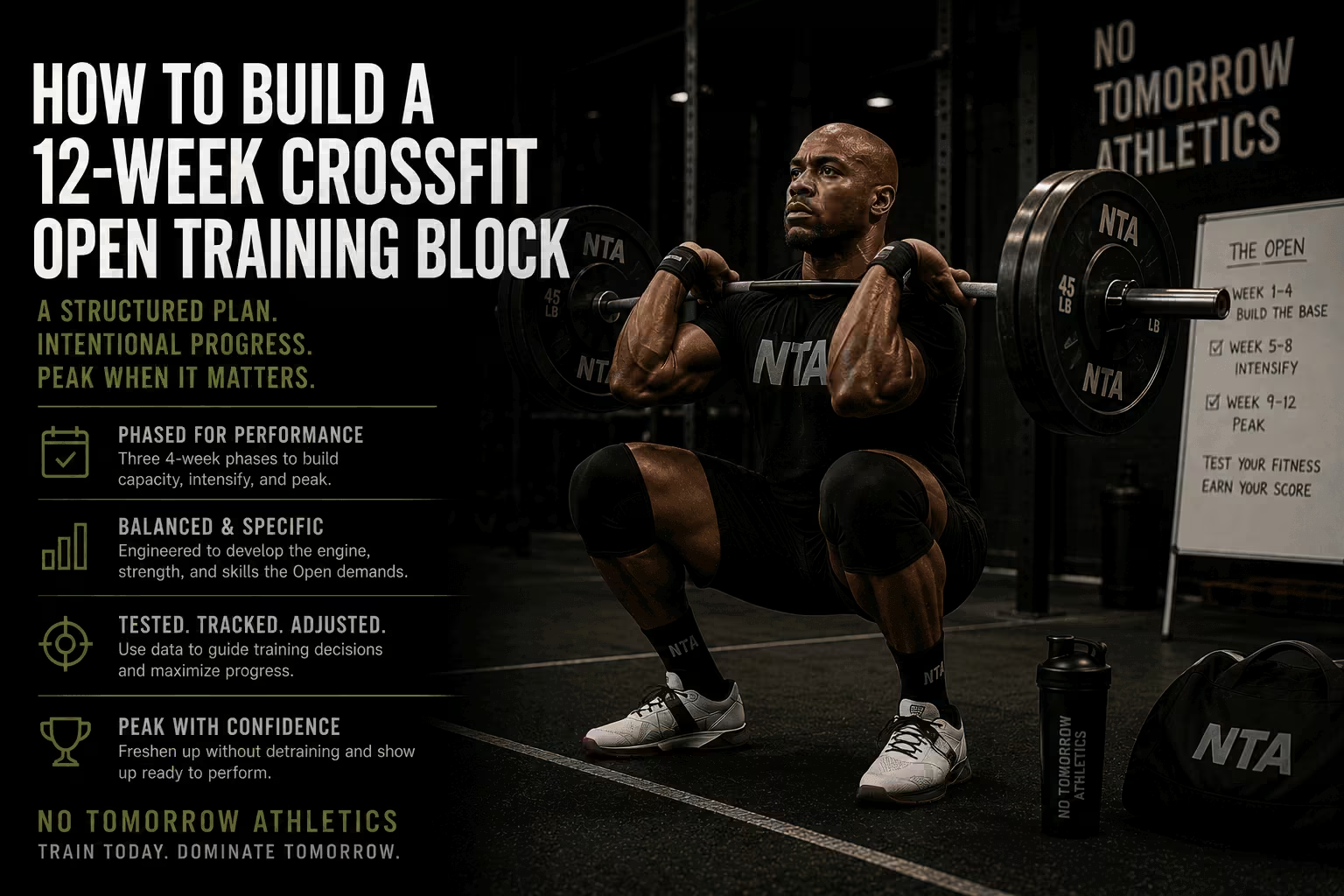
If you want to understand the training that makes this pacing framework work, start with our 12-week CrossFit Open program — it is built specifically to develop the aerobic base that sustainable pacing requires. And if you want context for how Masters athletes at NTA train year-round to arrive at Open season ready, the Masters training approach at No Tomorrow Athletics covers the methodology in full.
For a deeper breakdown of what each Open workout is actually testing — and why identifying your limiting factor is the first analytical step — see our post on what the CrossFit Open tests in Masters athletes.
Pacing is not a concession to age. At 40-plus, it is the single most leveraged performance variable you have. Build the fitness. Know your limiter. Hold the plan. Then let the clock run.
Sources
- Mangine GT, Feito Y, Tankersley JE, McDougle JM, Kliszczewicz BM. Workout Pacing Predictors of CrossFit® Open Performance: A Pilot Study. Journal of Human Kinetics, 2021.
- Wroblewski AP, Amati F, Smiley MA, Goodpaster B, Wright V. Chronic Exercise Preserves Lean Muscle Mass in Masters Athletes. The Physician and Sportsmedicine, 2011.
- Fragala MS, Cadore EL, Dorgo S, Izquierdo M, Kraemer WJ, Peterson MD, Ryan ED. Resistance Training for Older Adults: Position Statement From the National Strength and Conditioning Association. Journal of Strength and Conditioning Research, 2019.
- Tøien T, Unhjem R, Berg OK, Aagaard P, Wang E. Strength Versus Endurance Trained Master Athletes: Contrasting Neurophysiological Adaptations. Experimental Gerontology, 2023.
- Kent-Braun JA. Skeletal Muscle Fatigue in Old Age: Whose Advantage? Exercise and Sport Sciences Reviews, 2009.
Frequently Asked Questions
About the author




%20(1).avif)