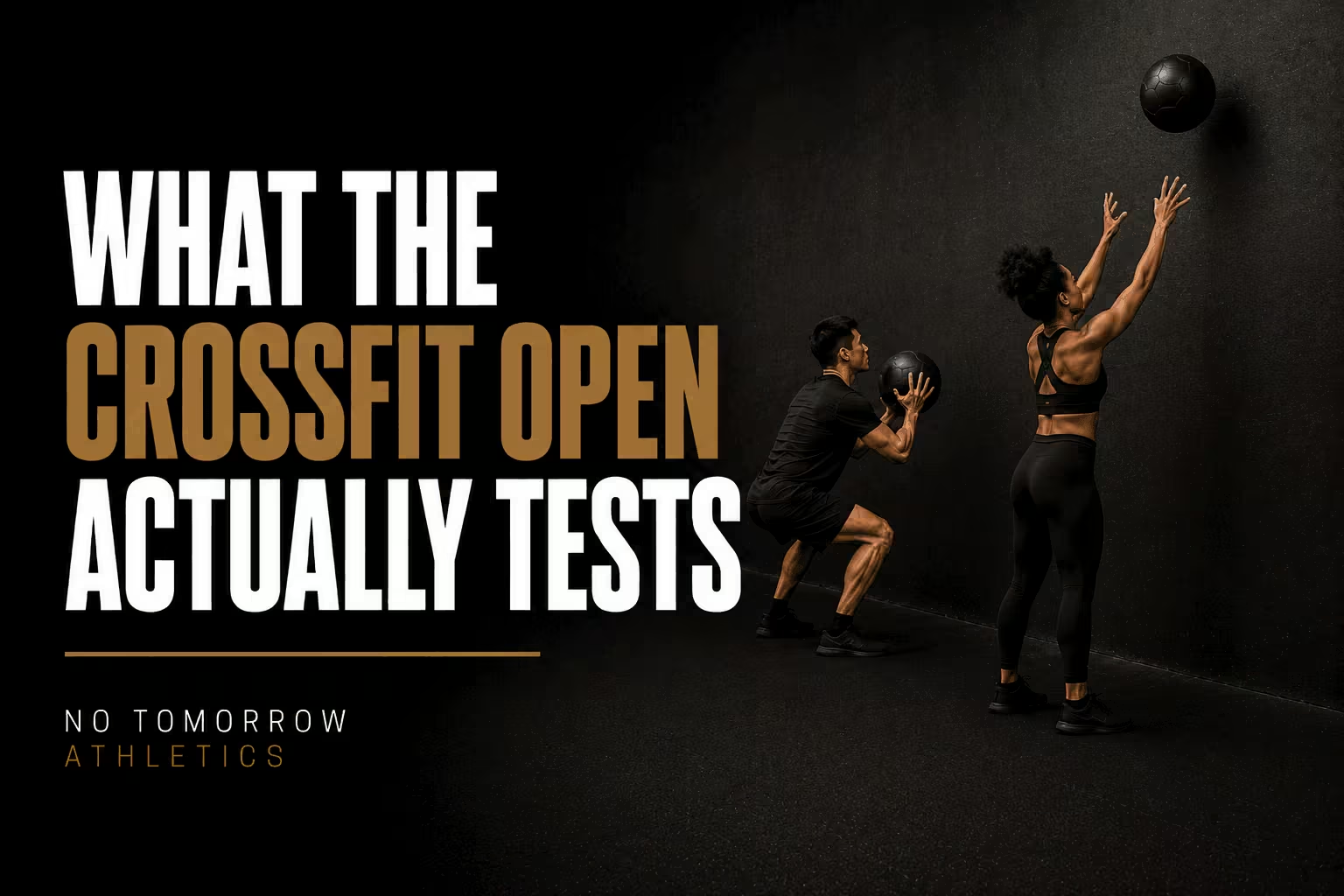
The Open does not care how much you can deadlift.
Every year, athletes who pull impressive numbers in the gym and move well in isolation hit the wall by round two of a 20-minute workout. They trained hard. They trained often. And they still ran out of gas before the clock did.
Understanding what does the CrossFit Open test is not a philosophical exercise. It is the first step to knowing where your score will stop — and what to do about it before the first workout drops.
What the Research Actually Shows
A 2024 study by Tibana et al., published in the European Journal of Translational Myology, examined performance predictors in amateur CrossFit athletes during Open-style competition. The finding was direct: aerobic capacity and local muscle endurance were the primary predictors of Open performance — stronger predictors than strength or power alone 1.
This is not a surprise to coaches who have watched the leaderboard for years. It is a confirmation.
The athlete who sustains output degrades less. The athlete who degrades less scores higher. Aerobic capacity determines how long you can sustain output before your movement quality breaks down. Local muscle endurance determines how many reps you can cycle before you have to break the set. Neither of those is a max-effort quality. Both are built over months, not weeks.
What the Open Has Always Asked For
A review of the CrossFit Open workout archive going back to 2011 reveals three movement categories that appear with consistent regularity across every season: gymnastics pulling movements, barbell cycling, and monostructural cardio.
Gymnastics Pulling
Pull-ups, toes-to-bar, chest-to-bar pull-ups, and muscle-ups appear in the Open every year. Not once. Multiple times, often within the same workout, often paired with a barbell movement that taxes the same anterior chain.
The athlete who can do 20 kipping pull-ups fresh will not do 20 kipping pull-ups in round three of a 15-minute AMRAP. The question the Open asks is how many you can still do in round three. That is a local muscle endurance question, not a skill question.
Barbell Cycling
Cleans, snatches, and thrusters at submaximal weights recur throughout Open history. The weights are almost never the limiting factor for a trained athlete at the percentage of one-rep max they are programmed. What ends the set is grip, breathing, and the ability to maintain positional integrity under accumulated fatigue 2.
The athlete who trains barbell cycling fresh, at low rep counts, with full rest between sets will not be ready. The Open asks you to cycle a barbell after you are already breathing hard.
Monostructural Cardio
Rowing, running, and double-unders appear consistently as either standalone pieces or transitions between higher-skill movements. In either role, they function as an aerobic tax. A slow row at the start of a workout becomes a very slow row by the end. An athlete with a weak aerobic base loses time on every transition.
The Self-Assessment: Three Tests, One Diagnosis
Before you build a prep plan, you need a diagnosis. The following three tests correspond directly to the three movement categories the Open tests most often. They are not maximums. They are minimums — the floor below which your score will be limited by that category before conditioning even becomes the variable.
Run all three in a single session. Rest five minutes between each. Write down your results.
Test 1 — Gymnastics Pulling
Can you perform 10 unbroken chest-to-bar pull-ups with consistent mechanics?
If the answer is no, gymnastics volume will limit your score before conditioning does. You will not be making strategic decisions about pacing in round three. You will be managing broken sets in round one. The rest of your fitness does not matter until this number is above 10.
Test 2 — Barbell Cycling
Can you cycle 10 unbroken barbell cleans at 135 lb for men or 95 lb for women with a consistent rhythm and full hip extension on every rep?
If the answer is no, barbell fatigue will end your workout before the clock does. This is not a strength problem. Athletes who can clean well above these numbers fail this test because they have never trained the barbell under sustained aerobic stress. Your limiting factor is cycling capacity, and that requires specific training to address 3.
Test 3 — Aerobic Base
Is your 2000m row under 8 minutes for men or under 9 minutes for women?
If the answer is no, your aerobic base is the limiting factor for everything else on this list. Local muscle endurance and skill hold longer when the aerobic system can support recovery between efforts. Without that base, every set of pull-ups takes longer to recover from. Every barbell complex costs more. A 2000m row over these thresholds is not a rowing problem — it is a cardiovascular problem that affects your entire score 14.
What Your Results Tell You About the Leaderboard
Each test failure has a specific consequence for where your score stops.
Fail Test 1 and you will lose significant time on gymnastics-heavy workouts in the first two rounds. You will be staring at the bar while athletes with better pulling endurance are still moving. No amount of aerobic capacity rescues you when you cannot string the reps.
Fail Test 2 and barbell workouts end for you before the intended stimulus occurs. The workout was designed to test metabolic output under load. If you are dropping the bar every two reps by minute five, you are not experiencing the workout as designed. You are experiencing a strength-endurance deficit that training at submaximal cycling loads would have addressed.
Fail Test 3 and you will hit the wall across all three categories. A weak aerobic base does not just hurt your rowing score. It slows your recovery between gymnastics sets. It limits how long you can sustain barbell cycling. It compresses the window in which your skill and strength are actually available to you. The aerobic base is the foundation. Everything else sits on top of it 12.
If you failed all three, start with Test 3. You cannot outwork an aerobic deficit with gymnastics skill or barbell technique.
How the No Tomorrow Method Closes the Gaps
The No Tomorrow Method at No Tomorrow Athletics is built around three pillars: Strength, Conditioning, and Mobility. Open preparation does not require you to abandon that structure. It requires you to apply it with specificity.
Gymnastics pulling capacity is built through progressive volume at submaximal effort — not by practicing max-effort sets to failure. Athletes who train to failure on pull-ups teach their nervous system to stop. Athletes who train below failure consistently build the local endurance that survives into round three.
Barbell cycling capacity is built by pairing barbell cycling with aerobic stress — not by cycling fresh. A clean complex at the end of a rowing piece is a different stimulus than a clean complex before anything else. No Tomorrow Athletics programs barbell work inside conditioning, not adjacent to it, because that is what the Open asks for.
Aerobic base is built over months. Twelve weeks is enough time to move the needle meaningfully if training is consistent and the aerobic work is progressively overloaded. It is not enough time if aerobic development has been neglected for years and the athlete is trying to fix everything at once 4.
If you are 35 or older, your self-assessment results are equally valid — but the prescription differs. Recovery between training sessions is a variable that younger athletes can ignore. Masters athletes cannot. The gaps identified here are the same gaps; the rate of adaptation and the training stress required to close them requires a different approach. See our Masters CrossFit prep guide for a prescription built around that reality.
Knowing your limiting factor also determines how you pace every workout in the Open. An athlete limited by gymnastics endurance should not open a chipper at the same effort level as an athlete limited by aerobic capacity. Your self-assessment results and your pacing strategy are the same conversation. Our guide to CrossFit Open Pacing walks through exactly how to use this diagnosis in real time during competition.
The 12-Week Prescription
A self-assessment without a program is just discouragement with extra steps.
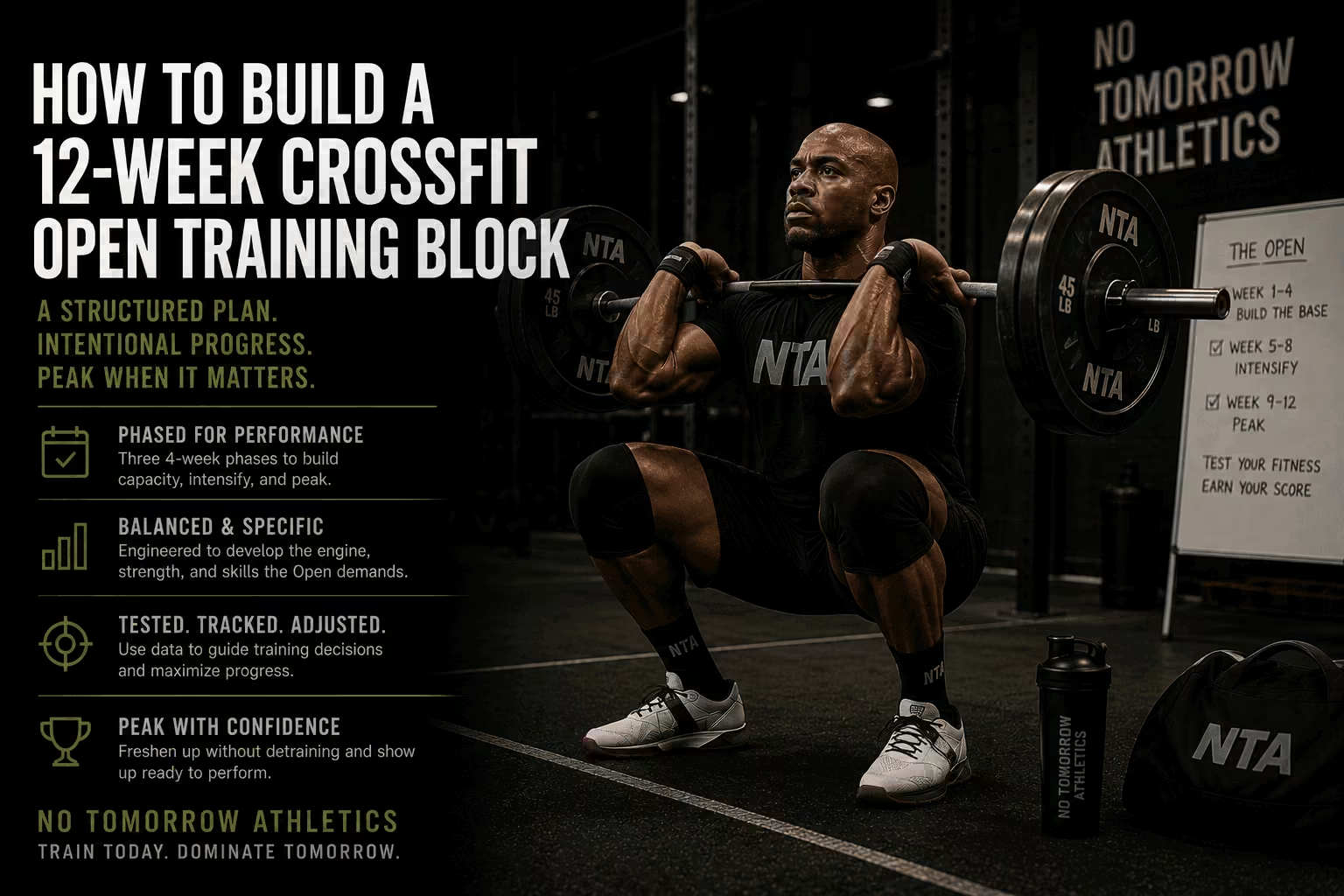
The 12-week CrossFit Open prep program at No Tomorrow Athletics is structured around the gaps in this self-assessment. Athletes who fail Test 1 train gymnastics volume differently than athletes who fail Test 3. The program is not generic Open prep. It is a structured response to what your tests revealed.
Twelve weeks is enough time to close one significant gap if you train with intention and consistency. It is not enough time to fix everything, which is why the self-assessment matters. You do not need to be excellent everywhere. You need to stop being exposed somewhere specific.
Find your floor. Build from there. The Open rewards the athlete who degrades the least — and you now know exactly where you would have degraded.
Sources
- Tibana RA, Dominski FH, Andrade A, de Sousa NMF, Voltarelli FA, Neto IVS. Exploring the Relationship Between Total Athleticism Score and CrossFit® Open Performance in Amateur Athletes: Single Measure Involving Body Fat Percentage, Aerobic Capacity, Muscle Power and Local Muscle Endurance. European Journal of Translational Myology, 2024.
- Butcher SJ, Neyedly TJ, Horvey KJ, Benko CR. Do Physiological Measures Predict Selected CrossFit Benchmark Performance? Open Access Journal of Sports Medicine, 2015.
- Bellar D, Hatchett A, Judge LW, Breaux ME, Marcus L. The Relationship of Aerobic Capacity, Anaerobic Peak Power and Experience to Performance in CrossFit Exercise. Biology of Sport, 2015.
- Kenney WL, Wilmore JH, Costill DL. Physiology of Sport and Exercise, 8th Edition. Human Kinetics, 2022.
Frequently Asked Questions
About the author

%20(1).avif)