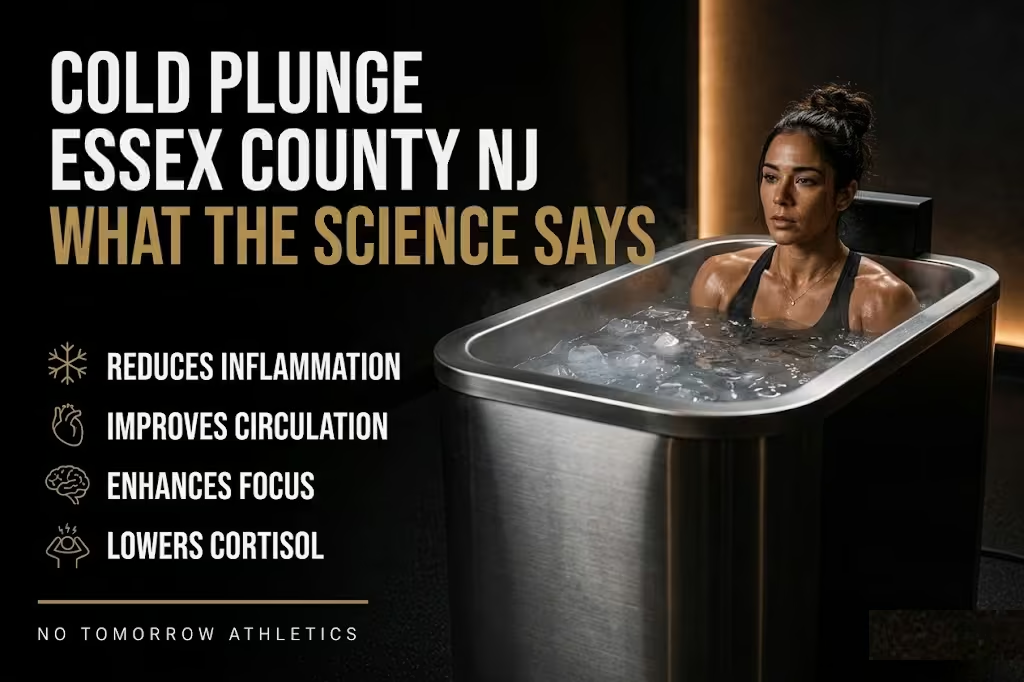
Most cold plunge setups you will find in Essex County are afterthoughts — a chest freezer in a corner, water that never gets checked, no protocol on the wall. The research does not support that approach. The research supports precision.
If you are looking for cold plunge in Essex County NJ, the first question is not where to find it. It is whether what you find is actually built to do the job. Cold exposure and contrast therapy have real physiological effects when administered correctly. They are inert, or worse, when they are not.
What the Research Actually Shows
In 2021, Søberg et al. published a landmark study in Cell Reports Medicine demonstrating that deliberate cold water immersion at temperatures between 50–59°F, totaling 11 minutes of exposure per week across multiple sessions, produced statistically significant increases in dopamine, norepinephrine, and basal metabolic rate 1. These are not small effects. Norepinephrine increased by up to 300 percent. Dopamine by up to 250 percent. These compounds govern mood, attention, and metabolic function — not for minutes after exposure, but for hours.
This is not a biohacking claim. It is a cellular response to controlled thermal stress.
Separately, contrast therapy, alternating between cold and heat, has been shown to accelerate autonomic nervous system recovery by enhancing parasympathetic reactivation post-exercise 2. The mechanism is vascular: cold causes vasoconstriction, heat causes vasodilation, and the alternating cycle functions as a pump for the peripheral circulatory system. Metabolic waste moves out. Oxygenated blood moves in. Systemic inflammation markers, including IL-6 and CRP, come down faster than with passive rest alone 3.
Cold Alone vs. Contrast Therapy: What Is the Difference
Cold Immersion Alone
Cold immersion at 50–59°F activates the sympathetic nervous system acutely — heart rate rises, breathing quickens, core temperature is defended. After the session, the body shifts toward parasympathetic dominance. This is the recovery window. Used correctly, cold alone improves mood, reduces perceived soreness, and clears the mental load of hard training.
Why Contrast Therapy Adds More
When you add structured heat, specifically infrared sauna in the 170–190°F range, between cold rounds, the vascular cycling effect compounds the benefit. A 2023 review in Sports Medicine confirmed that contrast water therapy produced greater reductions in delayed onset muscle soreness (DOMS) and faster restoration of strength and power output compared to cold alone, passive rest, or heat alone 4. The body is not just cooling down. It is being mechanically pumped.
At No Tomorrow Athletics, the Recovery Room is built around this principle. Cold plunge and infrared sauna are not two amenities next to each other. They are one tool used in sequence.
What Separates a Purpose-Built Recovery Room from a Hotel Spa
Temperature precision is the first separator. A cold plunge that runs at 62°F is not producing the same hormonal response as one calibrated to 52°F. The Søberg data was collected in a specific range. If you cannot verify the water temperature, you are guessing.
Plunge depth matters. Submersion to the neck is required to engage the full cold shock response and activate the thermoreceptors in the torso and shoulders. A tub that cuts off at the chest is a partial exposure.
Sauna temperature range matters. Infrared saunas operating between 170–190°F produce the core temperature elevation needed to drive the vasodilation side of the contrast equation. Below that range, you are warm. You are not recovering.
Protocol structure is what most facilities skip entirely. A purpose-built recovery room has a written protocol on the wall. It tells you how long to stay cold, how long to stay hot, how many rounds to run, and how to sequence it relative to your training that day. Without that, you are tourists in a spa.
The Recovery Room at No Tomorrow Athletics, serving athletes across Essex County, including contrast therapy in Livingston NJ, runs on a defined prescription, not a vibe.
The Exact Protocol
This is what the research supports and what we prescribe at No Tomorrow Athletics.
Contrast Protocol — Standard
- Cold plunge at 50–59°F for 2–3 minutes
- Infrared sauna at 170–190°F for 15–20 minutes
- Repeat for 2–3 rounds
- End on cold for hormonal benefit, or heat for muscular relaxation depending on goal
- Frequency: 2–3 sessions per week
Timing Relative to Training
Post-training use is for recovery — reducing systemic inflammation, clearing metabolic byproducts, restoring autonomic balance after hard conditioning or a Hyrox prep session. Although be sure to skip this if your goal is hypertrophy, as cold exposure can impede hypertrophic gains.
Morning use before training functions as activation — the norepinephrine and dopamine response from cold exposure sharpens focus and elevates readiness without the cortisol cost of an additional training session. This can be a very effective pre-workout tool to boost performance. Just make sure you leave ample time to warm your body back up.
The Important Warning for Strength Athletes
If your primary goal is muscle hypertrophy, do not cold plunge immediately after resistance training. This is not a minor caveat. A 2021 meta-analysis in the European Journal of Sport Science found that regular post-exercise cold water immersion significantly blunted long-term gains in muscle mass and strength compared to passive recovery, specifically by suppressing the acute inflammatory signaling — including satellite cell activation and mTOR pathway expression — that drives muscular adaptation 5.
The inflammation that follows a hard strength session is not damage to be extinguished. It is a signal. Cold immediately post-lift silences that signal.
If you are training to get stronger, cold plunge is a tool to use on conditioning days, between sessions, or at least four to six hours after lifting. Not the moment you rack the bar.
For more on how recovery integrates with resistance training programming, see our post on strength training at No Tomorrow Athletics.
Race Recovery and Competition Protocols
For Hyrox athletes and competitive CrossFit athletes in the days following a race or competition, contrast therapy is one of the most effective tools available. The combination of high-volume running, sled work, and metabolic output in a Hyrox race produces systemic inflammation and neuromuscular fatigue that standard rest does not resolve quickly.
Post-race contrast therapy, ideally within 24–48 hours, has been shown to reduce perceived fatigue and restore physical readiness faster than passive recovery alone 4. For athletes running multiple races in a season, this is not optional maintenance. It is part of the competitive calendar.
For a full breakdown of Hyrox training and competition strategy, see our Hyrox post.
Cold Plunge in Essex County NJ: What to Look For
If you are evaluating a cold plunge or recovery room facility in Essex County or anywhere in New Jersey, here is the checklist.
- Water temperature is monitored, displayed, and consistently held between 50–59°F
- Plunge depth allows full submersion to the neck
- Heat source reaches 170°F or above — infrared is preferred for penetrating tissue heat
- A written contrast protocol is available — not a suggestion, a prescription
- The space is purpose-built for performance recovery, not bolted onto a membership as a perk
- Staff understand the science and can answer questions about timing and training interaction
The Recovery Room at No Tomorrow Athletics was designed against this list. Cold plunge, infrared sauna, and compression therapy in one dedicated space. Not a spa. A training tool.
For a full overview of the No Tomorrow Method and how recovery fits into the broader programming structure, start with our hub post on training at No Tomorrow Athletics.
If you are in Essex County and serious about recovery, you now have the science, the protocol, and the location. The only variable left is whether you show up.
Sources
- Søberg S, Löfgren J, Philipsen FE, Jensen M, Hansen AE, Ahrens E, et al. Altered Brown Fat Thermoregulation and Enhanced Cold-Induced Thermogenesis in Young, Healthy, Winter-Swimming Men. Cell Reports Medicine, 2021.
- Buchheit M, Chivot A, Parouty J, Mercier D, Al Haddad H, Laursen PB, Ahmaidi S. Monitoring Endurance Running Performance Using Cardiac Parasympathetic Function. European Journal of Applied Physiology, 2010.
- Hohenauer E, Taeymans J, Baeyens JP, Clarys P, Clijsen R. The Effect of Post-Exercise Cryotherapy on Recovery Characteristics: A Systematic Review and Meta-Analysis. PLOS ONE, 2015.
- Higgins TR, Greene DA, Baker MK. Effects of Cold Water Immersion and Contrast Water Therapy for Recovery From Team Sport: A Systematic Review and Meta-Analysis. Journal of Strength and Conditioning Research, 2017.
- Fyfe JJ, Broatch JR, Trewin AJ, Hanson ED, Argus CK, Garnham AP, Halson SL, Polman RC, Bishop DJ, Petersen AC. Cold Water Immersion Attenuates Anabolic Signaling and Skeletal Muscle Fiber Hypertrophy, But Not Strength Gain, Following Whole-Body Resistance Training. Journal of Applied Physiology, 2019.
Frequently Asked Questions
About the author
.avif)
.avif)
.avif)