Most athletes spend the final four weeks before the CrossFit Open scrambling — hitting extra bar muscle-up drills, cramming double-under practice, trying to add twenty pounds to their clean. It doesn't work. The Open rewards fitness built over months, not skills patched together in a panic.
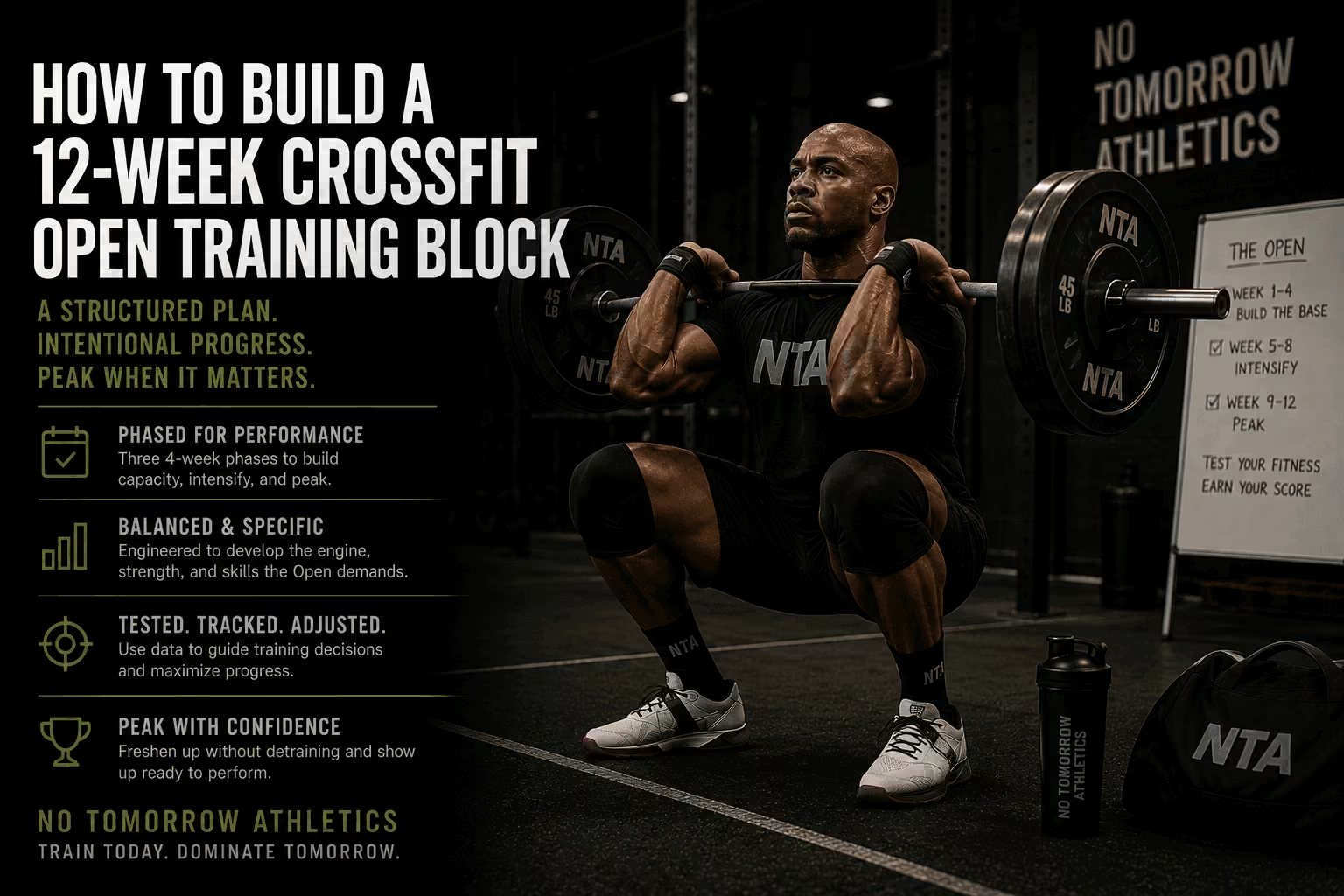
A structured CrossFit Open 12-week program solves the problem before it starts. At No Tomorrow Athletics, we build Open prep blocks around three parallel tracks: strength, conditioning, and mobility. Not in sequence. In parallel. Every week of every phase addresses all three, because the body doesn't compartmentalize and neither should your training.
Athletes deciding between CrossFit Open prep and Hyrox training are asking a real question — and the answer depends on what the sport actually demands from your body.
Why 12 Weeks Is the Right Window
Twelve weeks gives you enough time to build a real fitness base, develop competition-specific capacity, and sharpen without burning out. Eight weeks is usually too compressed to meaningfully move strength numbers while maintaining conditioning volume. Sixteen weeks can work, but most athletes lose focus or accumulate fatigue before they get to peak week.
The research supports a periodized approach. A 2022 meta-analysis in Sports Medicine confirmed that concurrent strength and endurance training — when structured correctly — produces superior performance outcomes to either modality trained alone 1. That's exactly what the Open demands: strength under fatigue, output sustained over time.
Twelve weeks also maps cleanly onto three four-week blocks. Each block has a distinct physiological target. None of them is optional.
The Three-Phase Structure
Phase 1 (Weeks 1–4): Base and Durability
This phase is not glamorous. It is necessary. The goal is to build the structural resilience that allows you to train hard for the next eight weeks without breaking down.
Strength work in Phase 1 centers on the foundational barbell lifts — squat, deadlift, press — at moderate loads and controlled tempo. The emphasis is position quality over load. If your squat mechanics deteriorate above 75% of your one-rep max, you are not ready to push intensity yet.
Conditioning sessions are longer and lower-intensity here. Think 20-to-30-minute aerobic pieces at conversational pace — rowing, cycling, running, light barbell cycling. The goal is building your aerobic engine, which will power every Open workout you do. Research from the Journal of Strength and Conditioning Research demonstrates that higher aerobic base capacity directly correlates with faster recovery between high-intensity intervals 2.
Mobility work in this phase addresses your limiting ranges. For most CrossFit athletes, that means hip flexor length, thoracic extension, and overhead shoulder range. Spend 15–20 minutes daily. Not as an afterthought — as a session.
Phase 2 (Weeks 5–8): Strength and Capacity
This is where the work gets serious. Phase 2 layers intensity onto the base you built. Strength loads increase. Conditioning sessions get shorter and harder. The two tracks begin to intersect.
Strength programming in Phase 2 should hit the movement patterns most common in the Open: squatting (front squat, goblet squat, overhead squat), hip hinge (deadlift, kettlebell swings, hang variations), and pressing overhead. Loads should climb toward 85–90% of one-rep max by the end of the phase. Accessory work targets posterior chain and shoulder stability — two areas that fail first in Open workouts.
Conditioning in this phase begins to resemble Open formats. Introduce EMOMs with barbell cycling. Add short AMRAPs at uncomfortable paces. Practice couplets and triplets that mix gymnastics with weightlifting. These sessions build the specific metabolic pathway the Open tests: repeated high-output efforts with incomplete recovery.
The athletes who struggle in the Open didn't miss a skill. They missed eight weeks of base work.
Mobility work shifts to active recovery between sessions. Introduce soft tissue work — foam rolling, lacrosse ball, targeted myofascial release — particularly for the thoracic spine, hip capsule, and ankle. A 2023 review in the International Journal of Sports Physical Therapy found that consistent soft tissue work during high-volume training blocks reduces acute injury incidence in strength-sport athletes 3.
Intensity management across a peaking block requires understanding how close to failure you should be training — and the answer has changed based on recent meta-analyses.
Phase 3 (Weeks 9–12): Competition Sharpening
Phase 3 is not more training. It is smarter training. Volume drops by 20–30% from Phase 2 peak. Intensity stays high. The goal is to arrive at Open week feeling sharp, not depleted.
Strength work shifts to lower volume, higher specificity. Hit the barbell patterns you'll see in Open workouts: clean and jerk cycling, thrusters, chest-to-bar pull-ups paired with squatting. Keep loads heavy but short. Three sets of three is more useful here than five sets of five.
Conditioning work in Phase 3 mirrors Open workout formats directly. AMRAPs of 7, 10, and 15 minutes. Couplets under a clock. One longer chipper per week to maintain stamina. Practice pacing strategy in these sessions — not just effort, but how you distribute effort. Most Open athletes go out too fast and pay for it.
Mobility and recovery become the priority variable in this phase. Sleep quality, nutrition timing, and readiness scores matter more in weeks 9–12 than they did in weeks 1–4. The training stress is already in the body. The job now is to let adaptation express itself.
Peaking for the Open without overreaching is the central challenge of the final four weeks — athletes who add volume here almost always arrive underprepared despite training more.
How the No Tomorrow Method Structures All Three Pillars
At No Tomorrow Athletics, we don't treat strength, conditioning, and mobility as separate programs running side by side. They are one program with different emphases depending on the day and week.
A typical training week in Phase 2 looks like this:
- Monday: Strength focus (back squat cluster + accessory posterior chain) / short conditioning finisher (10 minutes or less)
- Tuesday: Conditioning focus (20–25 minute EMOM, barbell cycling + gymnastics) / 15 minutes mobility post-session
- Wednesday: Active recovery — mobility session only, 30–40 minutes, full-body
- Thursday: Strength focus (deadlift + pressing) / conditioning finisher
- Friday: Conditioning focus (Open-format AMRAP or chipper) / soft tissue work
- Saturday: Long aerobic session or team conditioning / mobility to close
- Sunday: Full rest or 20-minute restorative mobility only
This structure keeps strength and conditioning work separated enough to avoid chronic fatigue accumulation while keeping both tracks active. It is not accidental. It is built from the same evidence base that serious strength and conditioning coaches have used with competitive athletes for decades 4.
The Most Common Programming Mistakes Before the Open
Even athletes with training experience make predictable errors in the final weeks before the Open begins.
Chasing Skills Too Late
If bar muscle-ups are not in your toolkit by week 8, week 11 practice sessions will not build them. Motor learning requires repeated exposure over time — not concentrated panic. Practice movements in Phase 1 and 2 so that by Phase 3, you are refining, not learning.
Underloading Strength Work
Many CrossFit athletes are better conditioned than they are strong. The Open consistently includes workouts where a heavier barbell limits output more than aerobic capacity does. If you are spending 80% of your training on conditioning and 20% on strength, your programming is likely misaligned with what the Open actually tests.
A 2022 study in the Journal of Strength and Conditioning Research found that maximal strength levels were among the strongest predictors of CrossFit competition performance, more predictive than VO2 max in mixed-modal events 5.
Skipping Mobility Work Until Something Hurts
Mobility work prevents the injuries that end Open prep early. An overhead squat you cannot perform in a warm-up is an overhead squat you will not perform well under fatigue at minute 12 of an AMRAP. Build range of motion during Phases 1 and 2, when training volume is manageable. Do not wait for pain to make it a priority.
Nutrition and Recovery Within the Block
Training is the stimulus. Everything outside of training is where adaptation happens.
Carbohydrate intake should scale with training load. Phase 2 and early Phase 3 — when volume and intensity are both high — require more carbohydrate than Phase 1 base work. A general target for performance athletes in heavy training is 4–7 grams of carbohydrate per kilogram of body weight per day, adjusted up or down based on session duration and intensity 6.
Protein distribution matters as much as total intake. Research published in Nutrients in 2022 confirmed that distributing protein across four or more meals produces superior muscle protein synthesis outcomes compared to the same total protein in fewer, larger meals 7. For a 180-pound athlete targeting 160 grams of protein per day, that means 40 grams at each of four meals — not 80 grams twice.
Sleep is not negotiable in a 12-week block. Seven to nine hours. Reduced sleep — even partial sleep restriction of 1–2 hours per night — meaningfully impairs both strength output and aerobic performance within 3–5 days 8.
Creatine is the one supplement with direct, replicated evidence for the type of high-intensity repeated-effort performance the Open demands.
How to Use This Block If You Train at No Tomorrow Athletics
No Tomorrow Athletics programs the No Tomorrow Method as a complete system. If you train here, this 12-week structure is built into your programming calendar. You do not need to self-program Open prep on top of your regular sessions.
If you train elsewhere or program for yourself, use this block as a structural guide. The phase targets, weekly volume distribution, and mobility integration principles translate to any serious training environment.
The Open rewards preparation. Twelve weeks, built right, is enough time to arrive ready.
Sources
- Schumann M, et al. Compatibility of Concurrent Aerobic and Strength Training for Skeletal Muscle Size and Function: An Updated Systematic Review and Meta-Analysis. Sports Medicine, 2022.
- Laursen PB, Jenkins DG. The Scientific Basis for High-Intensity Interval Training. Sports Medicine, 2002.
- Fousekis K, et al. Soft-Tissue Techniques in Sports Injuries Prevention and Rehabilitation. IntechOpen, 2021.
- Haff GG, Triplett NT. Essentials of Strength Training and Conditioning, 4th Ed.. NSCA/Human Kinetics, 2016.
- Böhm L, et al. CrossFit: 'Unknowable' or Predictable? A Systematic Review on Predictors of CrossFit Performance. Sports, 2023.
- Thomas DT, Erdman KA, Burke LM. Position of the Academy of Nutrition and Dietetics: Nutrition and Athletic Performance. Journal of the Academy of Nutrition and Dietetics, 2016.
- Trommelen J, et al. The Anabolic Response to Protein Ingestion During Recovery from Exercise Has No Upper Limit in Magnitude and Duration In Vivo in Humans. Cell Reports Medicine, 2023.
- Watson AM. Sleep and Athletic Performance. Current Sports Medicine Reports, 2017.
Frequently Asked Questions
About the author



%20(1).avif)