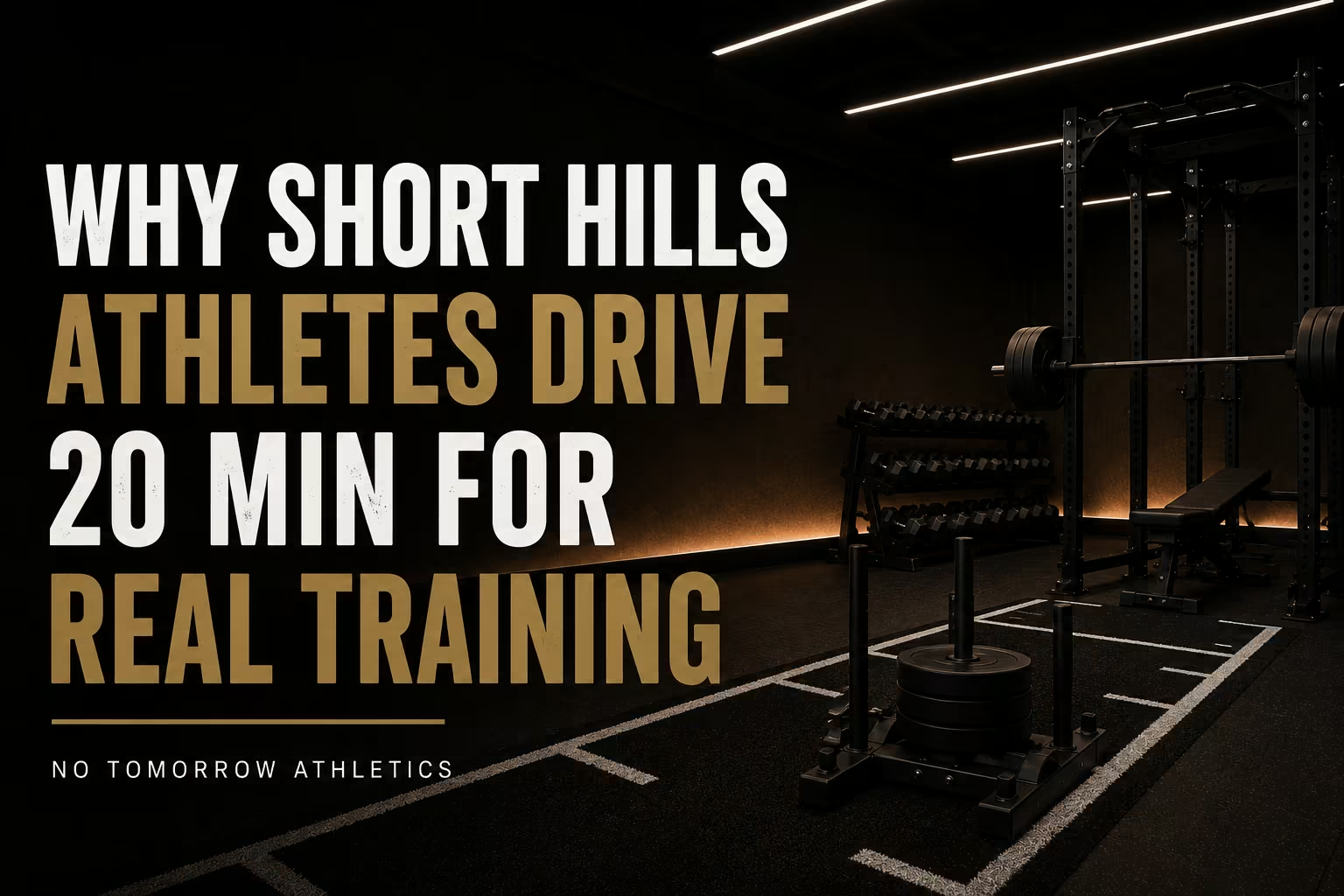
The most expensive gym membership in Short Hills is probably not the best one.
That is not an insult. It is a structural problem — and it is why athletes from Short Hills, Millburn, Chatham, and Summit are regularly driving 20 minutes or more to find coaching that actually works. If you want to understand what serious gym training in Essex County looks like, start here: the people most willing to invest in their fitness are often the least satisfied with what is available to them locally.
The Satisfaction Gap Nobody Talks About
High-income gym members spend two to three times the national average on fitness — and yet report lower satisfaction with programming quality than the general population 1. That number deserves a second read.
Affluent suburban adults are not underspending on fitness. They are overpaying for the wrong product. Boutique studios, upscale equipment floors, and recovery amenity packages charge premium prices — but none of those things constitute a training program.
The satisfaction gap exists because most premium gym offerings are built around aesthetics, ambiance, and convenience. What high-performing adults actually need is structure, measurable progression, and a coach who holds them accountable to a standard.
What Short Hills and Millburn Athletes Actually Want
The Short Hills and Millburn athlete profile is consistent. They are professionals with limited time, high standards, and a track record of executing when given a clear system. They are not looking for motivation. They are looking for a program worth executing.
They will pay for quality once they believe it is real. The problem is that most of what surrounds them in the 07078 and 07041 zip codes does not meet that standard — and they know it within the first few sessions.
So they drive. Not because they want to. Because the supply is not there.
The Commute Is a Symptom
When a group of people with high purchasing power and low tolerance for wasted time consistently commutes out of their area for a service, that is not a lifestyle choice. That is a market gap.
The commute to find serious coaching from Short Hills or Millburn is a symptom of one thing: local options that do not deliver results serious enough to justify continued attendance. A 20-minute drive to a gym that actually moves the needle is rational. Staying close to a facility that does not is the irrational choice.
No Tomorrow Athletics was built to close that gap. NTA is located in Essex County — close enough to Short Hills, Millburn, Chatham, and Summit to eliminate the commute, without compromising the standard those athletes came to expect from wherever they were driving to.
What a Results-Driven Program Actually Looks Like
The word "program" is overused in the fitness industry. It has come to mean anything from a PDF workout plan to a class schedule. That is not what we mean.
A results-driven program has four non-negotiable components.
1. Intake Assessment
Before the first session, a coach needs to understand movement history, injury history, current capacity, and the specific goals driving attendance. Without this, every subsequent session is a guess.
At No Tomorrow Athletics, intake is not a sales conversation. It is a coaching conversation. The information gathered there shapes everything that follows.
2. Benchmark Testing
You cannot measure progress without a starting point. Benchmark testing establishes where an athlete is across all three training pillars — not just the ones they are comfortable with.
Strong athletes often have weak conditioning. Conditioned athletes often have compromised mobility. Benchmark testing makes the full picture visible and removes the ability to hide in your strengths.
3. Structured Progression Across All Three Pillars
The No Tomorrow Method is built on three pillars: Strength, Conditioning, and Mobility. Each is trained deliberately and sequenced intentionally — not rotated randomly based on what sounds good that week.
Functional strength work follows a progressive overload model grounded in NSCA-supported principles 2. Volume and intensity are periodized. The goal is strength that lasts — not a peak followed by a plateau.
Conditioning work is anchored in aerobic base development — specifically Zone 2 training, which research from 2022 onward consistently identifies as the highest-yield investment for long-term cardiovascular capacity 3. Metabolic output is built on top of that foundation, not instead of it.
Mobility work is not a warmup. It is a pillar. Pliability, range of motion, and injury prevention are trained as seriously as a back squat. Recovery modalities, including cold exposure, are integrated into the overall program rather than treated as optional add-ons 4.
4. Progress Tracking and Scoring
Every benchmark gets retested. Every cycle produces data. Coaches review that data and adjust programming based on what the athlete's body is telling them — not based on a generic template.
This is what separates a program from a workout. The workout ends when the clock stops. The program is always in progress.
Why Short Hills and Millburn Athletes Respond to This Model
The professional who lives in Short Hills or Millburn has spent years being evaluated on output. They understand performance metrics. They understand that the absence of measurement is the absence of accountability.
When they walk into a gym that uses intake data, tracks benchmark results, and adjusts programming based on objective progress — they recognize it immediately. It looks like the rest of their professional life. It feels like something they can trust.
Research supports what those athletes already suspect: structured, coach-supervised programming produces meaningfully better outcomes than self-directed training, particularly for adults managing high cognitive loads and compressed training schedules 5. The Short Hills athlete does not have sessions to waste. A structured program ensures none of them are.
The best training session is the one you can repeat tomorrow.
You No Longer Have to Drive Out of the Area
No Tomorrow Athletics is in Essex County. Short Hills is 15 minutes. Millburn is 12. Chatham and Summit athletes are already training here.
Founding member spots are limited — not as a marketing tactic, but because the intake and onboarding process is built to be thorough. When you join, a coach knows your history, your benchmarks, and your program. That requires capacity management.
If you have been driving 20 minutes for serious training, or if you have been settling for something local that is not delivering, this is the option that has been missing. It is here now.
Sources
- Health & Fitness Association. 2023 U.S. Health and Fitness Consumer Report. Health & Fitness Association (formerly IHRSA), 2023.
- Lim C, Nunes EA, Currier BS, McLeod JC, Thomas ACQ, Phillips SM, Aguiar EJ. An Evidence-Based Narrative Review of Mechanisms of Resistance Exercise-Induced Human Skeletal Muscle Hypertrophy. Medicine and Science in Sports and Exercise, 2022.
- Burnley M, Jones AM. Power-Duration Relationship: Physiology, Fatigue, and the Limits of Human Performance. European Journal of Sport Science, 2018.
- Moore E, Fuller JT, Buckley JD, Saunders S, Halson SL, Broatch JR, Bellenger CR. Impact of Cold-Water Immersion Compared with Passive Recovery Following a Single Bout of Strenuous Exercise on Athletic Performance in Physically Active Participants: A Systematic Review with Meta-Analysis and Meta-Regression. Sports Medicine, 2022.
- Murlasits Z, Kneffel Z, Thalib L. The Physiological Effects of Concurrent Strength and Endurance Training Sequence: A Systematic Review and Meta-Analysis. Journal of Sports Sciences, 2018.
Frequently Asked Questions
About the author